


Neptune is the planet nobody saw coming — literally. These fun facts about Neptune begin with a world found by mathematics before any telescope pointed at it, out at the cold, dark edge of the solar system. It is the farthest planet from the Sun, yet it brews the fastest winds anywhere — and it may not even be the deep blue colour on all those posters.
Only one spacecraft has ever been there, a single flyby back in 1989, and scientists are still correcting the record: its moon count changed in 2024, and its famous colour turns out to have been exaggerated all along.
Below are 35 fun facts about Neptune in five themed groups — a planet predicted on paper, vanishing storms, a captured moon and rain that might be made of diamonds. First, the basics in a table.
Neptune Quick Facts
| Quick Fact | Detail |
|---|---|
| Planet type | Ice giant |
| Diameter | 49,528 km |
| Distance from the Sun | About 4.5 billion km (30 AU) |
| One day | 16.11 hours |
| One year | 164.8 Earth years |
| Average temperature | −201 °C |
| Moons | 16 |
| Largest moon | Triton |
| Fastest winds | More than 2,000 km/h |
| Discovered | 1846 |
| Predicted and found by | Le Verrier, Adams and Galle |
| Only spacecraft visit | Voyager 2 (1989) |
The Planet Maths Predicted
Our fun facts about Neptune begin with a detective story — a planet nobody had seen, tracked down with pencil and paper.
1. Neptune Was Found by Maths Before It Was Found by a Telescope
Neptune is the first planet located through mathematical predictions rather than regular sky-watching. Uranus kept drifting from its predicted path, so astronomers realised something unseen must be tugging on it. French mathematician Urbain Le Verrier calculated where the troublemaker had to be hiding — and the planet was sitting almost precisely where his equations said it would be.
2. It Was Spotted on the Very First Night of Searching
Le Verrier sent his prediction to Johann Gottfried Galle at the Berlin Observatory, and Galle found Neptune on his first night of searching, 23 September 1846. The prediction was off by only about one degree — a finger’s width against the sky. Few discoveries have landed so cleanly: the maths was done in Paris, and the planet simply turned up on cue in Berlin.
3. Two Mathematicians Solved It at the Same Time
Le Verrier was not working alone. In England, astronomer John Couch Adams had independently made similar calculations at around the same time, from the same wobbles in the path of Uranus. The two men never collaborated, yet both pointed at roughly the same patch of sky. Today they are credited jointly for predicting Neptune — a rare double win for mathematics.
4. Galileo Saw Neptune in 1612 — and Called It a Star
Neptune had been seen long before 1846; it just had not been recognised. Galileo recorded it in his observing notes in 1612 and 1613, more than 230 years before its official discovery, and logged it as a fixed star near Jupiter. In fairness, Neptune crawls so slowly across the sky that it barely moves from night to night — exactly what a distant star would do.
5. It Was Nearly Named Janus, Oceanus — or Leverrier
Before “Neptune” stuck, the new planet collected rival names. Galle suggested Janus, the two-faced Roman god; others proposed Oceanus, fitting for a blue world. Le Verrier, not exactly shy, put forward his own name: Leverrier. In the end Neptune, Roman god of the sea, won — matching the planet’s deep blue colour and starting a naming tradition that runs through all its moons.
6. Its Moons Are Named for Sea Gods and Nymphs
Neptune is named after the Roman god of the sea, and its family follows the theme. Every moon carries the name of a lesser sea god or a nymph from Greek mythology — Triton, Proteus, Nereid, Galatea and the rest. The whole system reads like a cast list from an ocean myth, fitting for a planet the colour of deep water.
7. Its Biggest Moon Turned Up Just 17 Days Later
The discoveries came thick and fast in 1846. On 10 October, just 17 days after Galle found the planet, English astronomer William Lassell spotted a large moon circling it. That moon, Triton, turned out to be by far the biggest of Neptune’s family — and, as later facts here show, the strangest. A whole new planet, then its giant moon, inside a single month.
The Farthest World
Next, our fun facts about Neptune travel outward: the distance, the darkness and the strangest calendar in the solar system.
8. Neptune Is the Most Distant Planet of All
Neptune is the eighth and most distant planet from the Sun, orbiting about 4.5 billion kilometres away — 30 astronomical units, or 30 times the Earth–Sun distance. Everything beyond it belongs to the Kuiper Belt and the deep dark. From that far out, the Sun shrinks to a brilliant point of light, and Neptune makes the slowest, longest journey of any planet.
9. Sunlight Takes Four Hours to Reach It
Light is fast, but Neptune is far. Sunlight needs about four hours to cross the gap, and by then it has thinned to roughly 900 times fainter than the sunshine Earth receives. High noon on Neptune would look like dim twilight to human eyes. It is also the only planet that cannot be seen with the naked eye at all — you need binoculars or a telescope.
10. Four Times Wider Than Earth — and the Densest Giant
Neptune measures 49,528 kilometres across, about four times wider than Earth, and holds about 17 times Earth’s mass. If Earth were the size of a nickel, Neptune would be about as big as a baseball. It is also the densest of the four giant planets — yet its gravity is only slightly stronger than Earth’s, about 1.15 times, so you would weigh just a little more there.
11. Its Day Is Shorter Than Ours
For all its size, Neptune spins quickly. One full rotation — one Neptunian day — takes about 16.11 hours, well under an Earth day. A world four times wider than ours turns itself around before your workday plus an evening is over. That rapid spin, in a planet wrapped in fluid, is part of the restless character that shows up again in its weather.
12. One Neptune Year Lasts 164.8 Earth Years
Neptune takes 164.8 Earth years — 60,189 Earth days — to circle the Sun once. That is so long that it completed its first full orbit since its discovery only in 2011. Everyone who found Neptune, photographed it and flew a spacecraft past it did so during its very first recorded year. We have known this planet for barely more than one of its birthdays.
13. Each Season Lasts More Than 40 Years
Neptune’s axis tilts at 28.32 degrees, similar to Earth’s tilt, so Neptune has proper seasons. The catch is the timescale: because one Neptunian year lasts nearly 165 Earth years, each season drags on for over 40 years. A Neptunian spring could begin in your childhood and still be going when your grandchildren are grown — astronomers have been tracking the same southern summer for decades.
14. Sometimes Pluto Sneaks Closer to the Sun Than Neptune
Neptune is the farthest planet, but not always the farthest world. Pluto’s tilted, oval orbit brings it inside Neptune’s orbit for 20 years at a time — most recently from 1979 to 1999. The two can never collide: for every three orbits Neptune completes, Pluto completes exactly two, a rhythm that always keeps them apart. Neptune’s gravity conducts the whole outer neighbourhood.
The Windiest World
More fun facts about Neptune appear when you look at its sky: record-breaking winds, storms that vanish, and a colour that is not quite what the posters promised.
15. Neptune Has the Fastest Winds in the Solar System
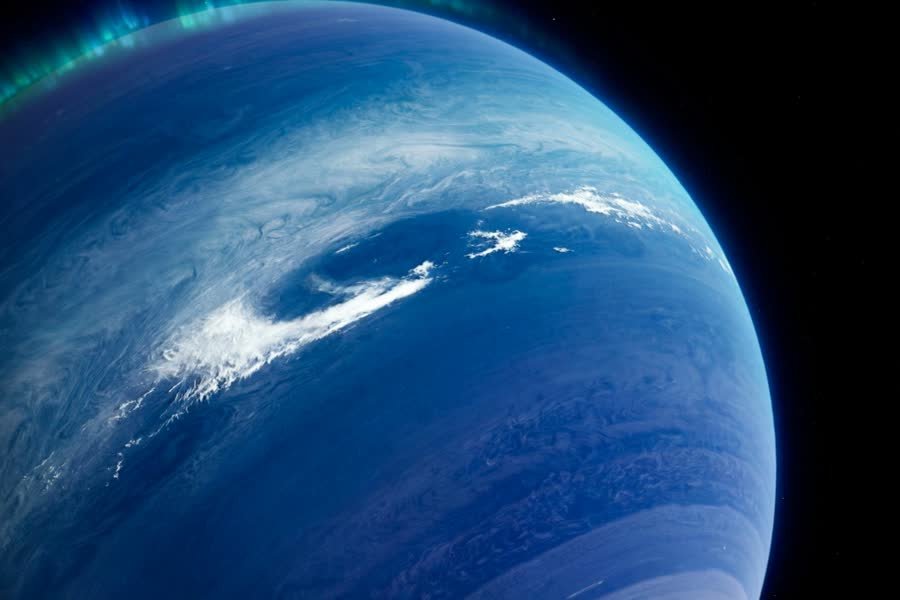
Neptune is the windiest world we know. Its winds whip clouds of frozen methane across the planet at more than 2,000 kilometres per hour — about three times stronger than Jupiter’s winds and nine times stronger than Earth’s most powerful. Nothing built by humans could stand in weather like that. The strangest part? All this fury runs on feeble, four-hour-old sunlight — a puzzle we will solve inside the planet.
16. Its Air Is Hydrogen, Helium and a Whisper of Methane
Neptune’s atmosphere is about 80 percent hydrogen and 19 percent helium, with roughly 1.5 percent methane mixed in. That small methane fraction does an outsized job: it shapes the planet’s colour, and frozen methane forms the bright clouds the great winds drag around the globe. There is no solid surface beneath it — the atmosphere deepens gradually into water and other melted ices over a solid core.
17. The Great Dark Spot Could Have Swallowed Earth Whole
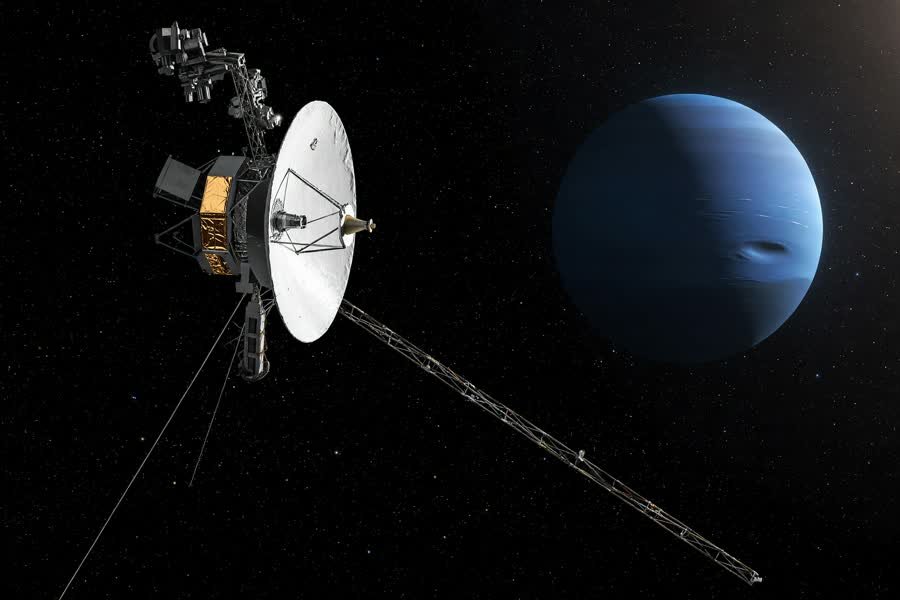
When Voyager 2 flew past in 1989, it found the Great Dark Spot: a giant oval storm in Neptune’s southern hemisphere, large enough to contain the entire Earth. Think of it as Neptune’s answer to Jupiter’s Great Red Spot — a colossal, dark, high-pressure system spinning in the blue. It was the showpiece of the flyby, proof that the farthest planet was anything but quiet.
18. The Great Dark Spot Then Vanished
Here is where Neptune’s storms part company with Jupiter’s. When the Hubble Space Telescope looked again, images showed the Great Dark Spot gone by 1994 — faded away within a few years. New dark spots have appeared elsewhere on the planet since, forming and dissolving like slow weather. Jupiter’s famous storm has raged for centuries; Neptune’s giants come and go within a decade of watching.
19. Voyager 2 Also Met “Scooter”
The Great Dark Spot had company. Voyager 2 photographed a bright, fast-moving cloud nicknamed “Scooter,” because it zipped around the planet faster than the features near it. A second storm, Dark Spot 2, sat not far from the great one. Together they painted a sky in constant motion — bright clouds racing one way, dark storms turning another, all at impossible speeds.
20. Neptune Is Blue Because of Methane
The famous blue has a simple cause. Methane in Neptune’s atmosphere absorbs red light and reflects blue light back into space, so the planet shines that rich, watery colour. It is the same basic trick that colours Uranus, though Neptune usually looks the deeper of the two. Or at least, that is how it has always looked in the pictures. The next fact is where the story turns.
21. Neptune Is Not as Blue as You Think
Many famous Neptune photos show a deep, vivid blue — but the Voyager 2 team enhanced those 1989 images to bring out the clouds and features. In 2024, researchers re-processed the original Voyager data with modern calibration and found Neptune’s true colour is a paler blue-green. The two ice giants actually look much more alike than the posters suggest. The deepest-blue planet was partly a darkroom effect.
Moons and Rings
Our fun facts about Neptune now turn to its family — sixteen moons, one captured giant, and rings that refuse to spread out.
22. Neptune Has 16 Moons — the Count Changed in 2024
Ask most websites and they will tell you Neptune has 14 moons. They are out of date. Neptune has 16 known moons: the count rose in February 2024, when two small irregular moons, provisionally named S/2021 N1 and S/2002 N5, were announced after deep telescope surveys led by Scott Sheppard’s team. They had been hiding in survey data, waiting for someone to look carefully enough.
23. One Moon Takes 27 Years to Go Around
One of the 2024 newcomers is a record-breaker. S/2021 N1 takes about 27 years to complete a single orbit of Neptune — the longest orbital period of any known moon in the solar system. It is also the faintest moon ever discovered from the ground, a speck so dim it needed years of stacked telescope images to confirm. Neptune’s outskirts are still frontier territory.
24. Proteus, the Big Moon Only a Spacecraft Could Find
Neptune’s second-largest moon hid from every telescope on Earth. Proteus, a dark and lumpy world about 420 kilometres across, was discovered by Voyager 2 in 1989 — it sits close to the planet, lost in Neptune’s glare from our viewpoint. Voyager 2 found six new moons during its brief flyby. Nearly everything in this system waited for a visitor to reveal it.
25. Hippocamp Was Found in Old Photographs
One Neptunian moon was discovered without anyone pointing a telescope at the sky. Hippocamp, one of Neptune’s smallest moons, was found in 2013 by astronomer Mark Showalter — by studying Hubble Space Telescope photos taken years earlier. The moon had been sitting in the archive all along, recorded but unnoticed, until someone compared old images frame by frame. Space data keeps giving long after the shutter closes.
26. Triton Is a Captured World That Orbits Backwards
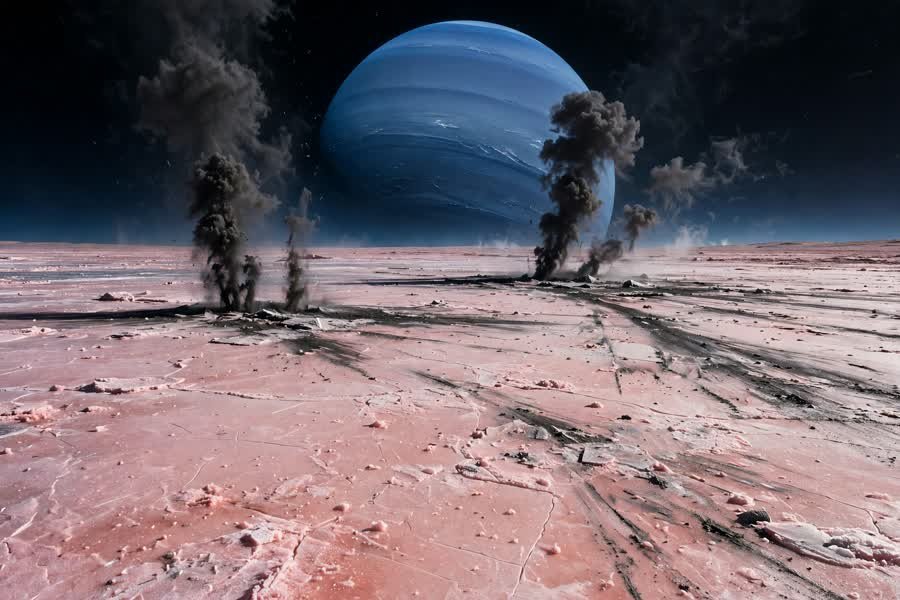
Triton is by far Neptune’s largest moon — 2,707 kilometres across, the seventh-largest moon in the solar system, holding about 99.5 percent of all the mass in orbit around Neptune. It is also the only large moon that orbits backwards, against its planet’s spin. That is the big clue: scientists believe Triton did not form around Neptune. It was once an independent Kuiper Belt world, captured by Neptune’s gravity.
27. Triton Has Geysers on One of the Coldest Surfaces Known
Triton’s surface sits at about −235 °C, making it one of the coldest measured places in the solar system. Yet Voyager 2 found it geologically alive: geysers spew icy material more than 8 kilometres into its thin nitrogen sky. Part of its surface is wrinkled into terrain like the rind of a cantaloupe — a landscape found nowhere else. Freezing, captured, and still erupting: Triton refuses to behave.
28. Triton Is Falling — and Will One Day Become a Ring
Triton’s story has a slow-motion ending. The great moon is gradually spiralling closer to Neptune, and in roughly 3.6 billion years it will cross the point where Neptune’s gravity tears it apart. Its debris is then expected to spread into a bright ring system far grander than the faint rings Neptune wears today. The captured world will end as its planet’s crown.
29. Five Faint Rings, With Arcs That Should Not Exist
Neptune has at least five main rings, named from the planet outward: Galle, Le Verrier, Lassell, Arago and Adams — honouring astronomers tied to its discovery. They are dark, dusty and thought to be relatively young. The outermost ring, Adams, holds four bright clumps called arcs — Liberté, Égalité, Fraternité and Courage — which should long ago have spread evenly around the ring. Scientists think the nearby moon Galatea’s gravity keeps them clumped. In 2022, the James Webb Space Telescope imaged the fragile system in infrared.
Inside Neptune
Finally, our fun facts about Neptune go beneath the clouds: leftover heat, a possible ocean of slush, and a magnet tipped on its side.
30. Neptune Glows With Heat Left Over From Its Birth
Here is the answer to the wind puzzle. Neptune radiates about 2.6 times as much energy as it receives from the distant Sun — the largest such excess of any planet. The planet is still leaking heat left over from its formation, and that internal warmth is the leading explanation for its violent weather. Strangely, its upper atmosphere is also unexpectedly hot, around 477 °C — something scientists still cannot fully explain.
31. The Farthest Planet Is Not the Coldest
You would expect the farthest planet to be the coldest, but Neptune’s own heat spoils the logic. At cloud level it is bitter enough — about −201 °C where pressure matches Earth’s at sea level, and down to about −218 °C higher up. Yet Uranus, one step closer to the Sun, has recorded lower temperatures, around −224 °C. The coldest-planet title belongs to Uranus.
32. A Slush Ocean Wrapped Around an Earth-Sized Core
More than 80 percent of Neptune’s mass is a hot, dense fluid of “icy” materials — water, methane and ammonia — wrapped around a small rocky core. That core alone has about the same mass as Earth. Scientists think there may be an ocean of super-hot water deep beneath the cold clouds; it does not boil away only because the incredible pressure keeps it locked in.
33. It Might Rain Diamonds in There
Deep inside Neptune, the pressure is so crushing that scientists believe methane may break apart and its carbon may crystallise into diamonds, which then rain down toward the core. To be clear, this “diamond rain” is a theory, not an observation — no spacecraft has seen it. But laboratory experiments recreating ice-giant conditions have produced the effect on a tiny scale, which is why researchers take it seriously.
34. Its Magnetic Field Is Tipped 47 Degrees
Neptune’s magnetic field refuses to line up. It is tipped about 47 degrees from the planet’s rotation axis and offset from the centre, so the whole magnetosphere swings wildly as Neptune rotates. The field is also about 27 times more powerful than Earth’s. Scientists suspect the tilt says something about how ice giants generate their magnetism — in a slushy layer, not a neat metal core.
35. Its Auroras Glow in the Wrong Places — and Webb Finally Saw Them
Because the magnetic field is so tilted, Neptune’s aurorae do not gather over the poles like Earth’s. They appear at mid-latitudes instead, in the “wrong” places entirely. They were also maddeningly hard to catch — until 2025, when the James Webb Space Telescope captured Neptune’s aurorae in detail for the first time. Nearly four decades after Voyager 2, the farthest planet is still handing us firsts.
Why Neptune Still Surprises Scientists
Neptune keeps rewriting its own story: a planet found by maths, a colour corrected after 35 years, a moon count quietly raised to 16. If these fun facts about Neptune have whetted your appetite, our collection of fun facts about space covers the whole solar system. You can also meet the swiftest planet in our fun facts about Mercury, or the red world in our fun facts about Mars.
The story is nowhere near finished: Webb is watching its auroras, telescopes keep finding its moons, and no spacecraft has returned since 1989. For the latest from the source, NASA’s Neptune page is the one to watch. Expect some of these fun facts about Neptune to be sharpened, or overturned, within years.
Fun Facts About Neptune — Frequently Asked Questions
Still curious? Here are short answers to the questions these fun facts about Neptune raise most.
Neptune has 16 known moons. The count stood at 14 for years, which is why many websites still say 14, but two small moons — provisionally named S/2021 N1 and S/2002 N5 — were announced in February 2024 after deep telescope surveys. Triton is by far the largest, and S/2021 N1 takes about 27 years to orbit: the longest of any known moon.
Neptune looks blue because methane in its atmosphere absorbs red light and reflects blue. But the deep, vivid blue in the famous Voyager 2 photos was enhanced to show off clouds and features. When researchers re-processed the original data in 2024, Neptune’s true colour turned out to be a paler blue-green — much closer to Uranus than the posters suggest.
Only one, ever: NASA’s Voyager 2, which flew past on 25 August 1989 and gave us nearly everything we know about the planet, its rings and its moons. No mission has gone back since. Everything newer — the corrected colour, the aurora images, the extra moons — has come from telescopes, including Hubble and the James Webb Space Telescope.
Neptune’s winds exceed 2,000 kilometres per hour, the fastest in the solar system — about nine times stronger than Earth’s most powerful winds. The surprising engine is heat from inside: Neptune radiates about 2.6 times as much energy as it receives from the Sun. That escaping warmth stirs the atmosphere into record-breaking weather, even at 30 times Earth’s distance from the Sun.
More Neptune Questions, Answered
Triton is Neptune’s largest moon, 2,707 kilometres across, making up about 99.5 percent of all the mass orbiting Neptune. It is the only large moon that orbits backwards, against its planet’s spin — the main clue that it did not form around Neptune. Scientists believe Triton began life as an independent Kuiper Belt world, captured by Neptune’s gravity.
It might — but nobody has seen it happen. The idea is a theory: at the crushing pressures deep inside Neptune, methane may break apart and its carbon may crystallise into diamonds that sink toward the core. Laboratory experiments recreating those conditions support the theory, but it remains unobserved. Any article stating it as settled fact is ahead of the evidence.
Uranus was not following its predicted orbit, so Urbain Le Verrier in France and John Couch Adams in England independently calculated where an unseen planet must be pulling it. Le Verrier sent his figures to Johann Galle in Berlin, who found Neptune on his first night of searching, 23 September 1846 — within about a degree of the prediction.
Not with anything flying today. Neptune is about 4.5 billion kilometres away — even a radio signal needs four hours to reach it — and only one uncrewed spacecraft has ever made the trip, in 1989. There is also nowhere to land: no solid surface, just atmosphere deepening into slush under crushing pressure, with −201 °C cold and 2,000 km/h winds above it. For now, Neptune belongs to telescopes.