


Jupiter is the planet that nearly runs the solar system. These fun facts about Jupiter begin with a world so massive that the Sun itself wobbles around it — a giant with the shortest day, the biggest storm and a moon count the rest of the internet keeps getting wrong.
A NASA spacecraft has been circling it for ten years now, and the surprises keep coming: the core turned out to be fuzzy, the famous storm is quietly shrinking, and fourteen new moons were confirmed in a single month of 2026.
Below are 35 fun facts about Jupiter in five themed groups — the king of planets, its record-breaking spin, the shrinking Great Red Spot, its 115 moons, and the strange world hidden beneath the clouds. First, the basics in a table.
Jupiter Quick Facts
| Quick Fact | Detail |
|---|---|
| Position from the Sun | 5th planet |
| Planet type | Gas giant |
| Diameter | 139,822 km |
| Mass | 318 times Earth’s |
| Distance from the Sun | About 778 million km (5.2 AU) |
| One day | 9.9 hours |
| One year | 11.86 Earth years (4,333 days) |
| Cloud-top temperature | −145 °C |
| Moons | 115 |
| Rings | 4 faint dust rings |
| Gravity | About 2.4 times Earth’s |
| Named after | Jupiter, Roman king of the gods |
The King of Planets
Our fun facts about Jupiter start with the sheer scale of the place — a planet that outweighs everything else put together.
1. Jupiter Is the Largest Planet of All
Jupiter measures 139,822 kilometres across, about 11 times wider than Earth. NASA puts it neatly: if Earth were the size of a grape, Jupiter would be about as big as a basketball. Nothing else in the solar system comes close.
2. It Outweighs All the Other Planets Combined — Twice Over
Jupiter’s mass is about 318 times Earth’s. Add up every other planet — Saturn, Neptune, Earth, Venus, all of them — and Jupiter still holds more than twice their combined material. That enormous gravity is why Jupiter calls so many shots in the solar system: comets get captured, asteroids get nudged, and whole families of moons stay in line.
3. About 1,300 Earths Could Fit Inside It
By volume, Jupiter could swallow roughly 1,300 Earths. Picture every continent, ocean and mountain on our planet poured into a hollow Jupiter — then doing it again more than a thousand times over. Humbling arithmetic, and a clue to why astronomers treat Jupiter as a system in its own right.
4. Jupiter Is the Oldest Planet
Jupiter formed about 4.6 billion years ago, from the dust and gas left over after the Sun ignited — before the other planets took shape. It grabbed most of the material the Sun left behind, then settled into its current orbit, fifth from the Sun, around 4 billion years ago. Earth, by comparison, is a latecomer built from the leftovers of the leftovers.
5. It Is Named for the King of the Roman Gods
The biggest planet got the biggest name: Jupiter, king of the gods in Roman mythology. The theme runs through the whole family — most of its moons are named for mythological figures linked to Jupiter or to Zeus, his Greek counterpart: lovers, attendants and characters from the old stories, circling their king.
6. Jupiter Has a Star’s Ingredients — but Never Ignited
Here is a favourite what-if. Jupiter is made of the same stuff as the Sun, mostly hydrogen and helium, yet it never became a star. To ignite hydrogen fusion it would need roughly 80 times more mass. So “failed star” is really just a nickname — Jupiter was never close. It stayed a planet, albeit one built from a star’s recipe.
7. Jupiter Does Not Quite Orbit the Sun
This one bends the textbook picture. Jupiter is so heavy that the balance point of the Jupiter–Sun pair — the spot both bodies actually circle — sits outside the Sun’s surface. So the Sun wobbles gently around that point while Jupiter swings around it too. Strictly speaking, Jupiter is the only planet that does not orbit a point inside its star.
8. There Is No Surface — Just the Largest Ocean in the Solar System
You could never land on Jupiter, because there is nothing to land on. The swirling gas simply thickens as you descend, becoming a vast ocean of liquid hydrogen — the largest ocean in the solar system, made of hydrogen instead of water. Any spacecraft trying to fly through would be crushed, melted and vaporised by the pressure and heat long before it found anything solid.
The Fastest Spinner
Next, our fun facts about Jupiter spin up: the shortest day of any planet, stripes that flow in opposite directions, and winds that would flatten a hurricane.
9. Jupiter Has the Shortest Day in the Solar System
For all its bulk, Jupiter turns faster than any other planet. One full spin — one Jovian day — takes just 9.9 hours, about 9 hours and 56 minutes. A world 11 times wider than Earth hauls itself around in less time than a long workday. That furious rotation drives almost everything else on this list, from the bulging waistline to the stripes.
10. Yet One Jupiter Year Lasts Nearly 12 Earth Years
The days fly by, but the years crawl. Jupiter trundles around an orbit averaging 778 million kilometres from the Sun, and one full circuit takes 11.86 Earth years — 4,333 Earth days. A child born on the day a Jupiter year begins would be starting secondary school by the time it ended. Short days, long years: Jupiter lives life at two speeds at once.
11. It Spins So Fast That It Bulges at the Waist
All that spinning flings Jupiter’s equator outward. Its equatorial radius is about 71,492 kilometres, while the pole-to-pole radius is only about 66,854 — a difference of more than 4,600 kilometres. Even in a small telescope, Jupiter looks slightly squashed rather than perfectly round: the most visibly out-of-shape planet in the solar system.
12. Jupiter Barely Tilts — So It Has Almost No Seasons
Earth’s 23-degree lean gives us summer and winter. Jupiter’s axis tilts by only about 3 degrees, so the giant spins almost perfectly upright. There are no strong seasons, no long polar nights sweeping across hemispheres — just the same striped face, turning under steady sunlight, year after 12-year year.
13. The Stripes Are Rivers of Cloud Flowing in Opposite Directions
Jupiter’s bands have names: the dark, orange-brown stripes are belts, and the paler bands between them are zones, and they stream east and west in opposite directions. The clouds stack in three layers spanning about 71 kilometres — ammonia ice on top, ammonium hydrosulfide crystals in the middle, and water ice and vapour down below. It is weather organised on a planetary scale.
14. Its Winds Reach 539 km/h — and Plunge 3,200 km Deep
The jet streams separating those belts and zones can hit 539 kilometres per hour at the equator, dwarfing Earth’s worst hurricanes. And they are not a surface skin. NASA’s Juno spacecraft found the jets run about 3,200 kilometres deep into the planet — the stripes on Jupiter are the visible top of rivers of gas thousands of kilometres tall.
15. Sunlight Takes 43 Minutes to Get There — Yet Jupiter Shines in Our Sky
Light leaving the Sun needs 43 minutes to reach Jupiter, and arrives at barely 4 percent of the strength we enjoy on Earth. Even so, Jupiter is one of the brightest objects in our night sky, outshone only by the Sun, the Moon and Venus. People have watched it since prehistory — Babylonian astronomers were logging its movements by the 7th or 8th century BC.
The Great Red Spot
More fun facts about Jupiter gather around its most famous feature: a storm wider than Earth that has raged for centuries — and is quietly shrinking.
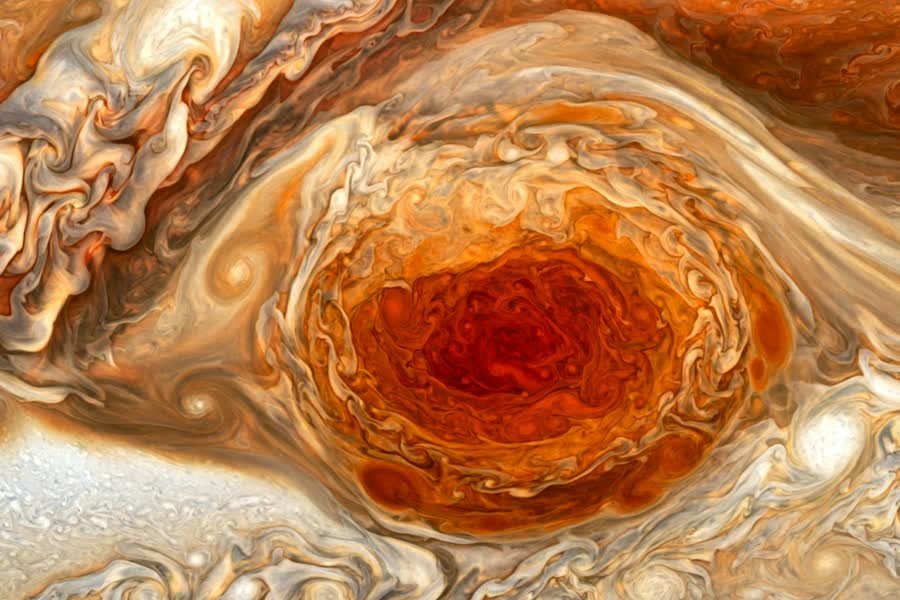
16. The Great Red Spot Is a Storm Bigger Than Earth, Raging for 300 Years
The Great Red Spot is a colossal anticyclone — a spinning high-pressure storm — that NASA currently describes as twice as wide as Earth. It has been observed for more than 300 years, making it the largest and longest-lived storm known anywhere. Earthly hurricanes measure their lives in days. This one has outlasted every nation currently on the map.
17. The Great Red Spot Is Shrinking
Here is the part the posters leave out. In the late 1800s, the Spot stretched about 41,000 kilometres across — wide enough for nearly three Earths in a row. By 2017 it measured roughly 16,000 kilometres, about 1.3 Earths wide. It is still wider than our whole planet today, but the trend has run one way for over a century. The solar system’s most famous storm is slowly winding down, and nobody knows exactly when — or whether — it will fade away.
18. The Spot Is About 500 km Deep
Juno did more than photograph the Spot; it weighed it. Flying over twice, the spacecraft measured the storm’s gravity signature and pinned its depth at about 500 kilometres below the cloud tops. Other Jovian storms reach 100 to 350 kilometres down. These are not shallow swirls in a thin sky — they are towering structures rooted deep in the planet.
19. Three Storms Merged to Make a Second Red Spot
The Great Red Spot has a younger sibling. Around the turn of this century, three smaller white ovals collided and merged into one storm, which then blushed red a few years later — the Little Red Spot, formally Oval BA. At about half the size of its famous cousin, it is still wider than many a planet’s entire weather system, and it proves the big one is not a one-off.
20. Jupiter’s Poles Wear Crowns of Cyclones in Perfect Patterns
Before Juno, nobody had seen Jupiter’s poles properly. They turned out to be astonishing: eight giant cyclones arranged in an octagon around the north pole, and five in a pentagon around the south. Stranger still, the patterns hold. The cyclones barely drift, because the central storm at each pole pushes back any that wander — a stand-off that has kept the crowns in place for years.
Moons and Rings
Our fun facts about Jupiter now move outward to its enormous family — more than a hundred moons, four of them worlds in their own right, plus a set of rings nobody expected.
21. Jupiter Has 115 Moons — and Most Websites Get the Number Wrong
Ask the internet and you will be told Jupiter has 79 moons, or 95. Both answers are out of date. Jupiter has 115 moons officially recognised by the International Astronomical Union — and the count jumped twice in 2026 alone, with four moons confirmed in March and fourteen more in April. Most of the newcomers are tiny captured rocks a few kilometres wide, but the family keeps growing every time telescopes look carefully.
22. Galileo’s Four Moons Changed Astronomy Forever
In January 1610, Galileo Galilei pointed an early telescope at Jupiter and saw four small “stars” lined up beside it — Io, Europa, Ganymede and Callisto. Night after night they shifted position but never left Jupiter’s side: they were orbiting it. It was the first direct proof that not everything in the sky circles the Earth, and it quietly cracked the old universe wide open.
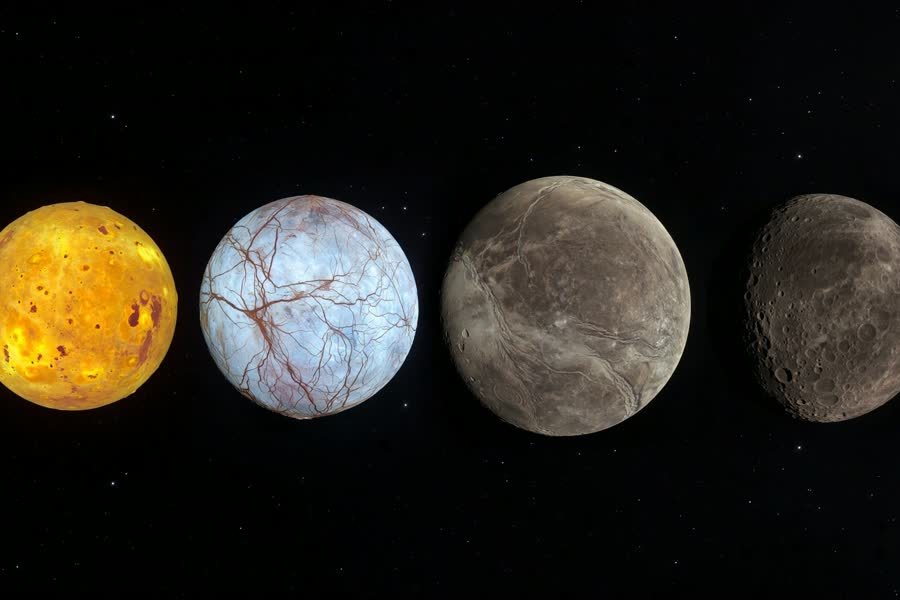
23. Io Is the Most Volcanically Active World Known
Io, the innermost of Galileo’s four, is a volcanic maniac. Hundreds of volcanoes erupt across its yellow, sulphur-stained surface, constantly repainting it. The cause is Jupiter itself: the planet’s gravity kneads Io like dough as the moon’s orbit flexes, and that tidal squeezing melts the inside. Io is the most volcanically active body in the entire solar system — and it is not close.
24. Europa Hides an Ocean — and a NASA Spacecraft Is on Its Way
Europa’s smooth, cracked ice is believed to cover a global ocean of liquid water — one of the most promising places anywhere to search for life. NASA’s Europa Clipper launched on 14 October 2024 to find out more. It arrives in April 2030 and will make 49 close flybys of Europa, sniffing and scanning the ice to judge whether that hidden ocean could support life. It will not land — but it is the biggest mission ever sent to an ocean world.
25. Ganymede Is Bigger Than Mercury — and Has Its Own Magnetic Field
Ganymede is the largest moon in the solar system, wider than the planet Mercury. It is also unique among moons: the only one known to generate its own internal magnetic field, the way Earth and Jupiter do. A moon bigger than a planet, with a magnetosphere of its own — Ganymede blurs every tidy category astronomers try to put it in.
26. Callisto Is a 4-Billion-Year-Old Time Capsule
Callisto, the outermost Galilean moon, wears one of the most heavily cratered surfaces known — an ancient landscape that has barely changed in some four billion years. Where Io resurfaces itself constantly and Europa’s ice keeps renewing, Callisto simply kept every scar. It is the solar system’s memory: a record of the bombardments every other world has since erased.
27. Europe’s JUICE Spacecraft Arrives in 2031
Jupiter is about to get crowded. The European Space Agency’s JUICE spacecraft — Jupiter Icy Moons Explorer — launched in April 2023 and is cruising toward a July 2031 arrival. It will tour Ganymede, Europa and Callisto, then settle into orbit around Ganymede: the first time a spacecraft has ever orbited another planet’s moon. Between JUICE and Europa Clipper, the 2030s belong to Jupiter’s icy moons.
28. Jupiter Has Rings Too — They Were a Complete Surprise
Saturn gets the glory, but Jupiter has four faint rings of its own, made of small, dark dust grains so dim they show up best when backlit by the Sun. Nobody expected them: NASA’s Voyager 1 discovered them in 1979. Later data showed where the dust comes from — meteoroids smashing into Jupiter’s small inner moons and kicking debris into orbit, grain by grain.
29. In 1994, a Comet Slammed Into Jupiter While the World Watched
Jupiter’s gravity had torn the comet Shoemaker-Levy 9 into a string of fragments — and in July 1994 they ploughed into the planet one after another over about a week. It was the first collision between two solar-system bodies ever observed, watched live by the Hubble Space Telescope and observatories everywhere. The impacts left dark scars in the clouds that lingered for months: a front-row demonstration of what Jupiter’s gravity can do.
Inside Jupiter
Finally, our fun facts about Jupiter dive beneath the clouds, where a decade of Juno data has rewritten what the giant is actually made of.

30. Jupiter’s Core Is Fuzzy
Textbooks used to draw Jupiter with a neat, solid core. Juno’s gravity measurements say otherwise. The core is much larger than expected and partially dissolved — a “dilute,” fuzzy core with no sharp edge, blending gradually into the layers above it. One leading idea is that a colossal collision early in Jupiter’s history smashed the original core apart. The king of planets, it turns out, has a blurred heart.
31. Halfway Down, Hydrogen Turns Into Liquid Metal
Descend far enough and the pressure does something extraordinary: it squeezes hydrogen until electrons are torn from its atoms, and the liquid starts conducting electricity like a metal. This ocean of metallic hydrogen is the engine room of Jupiter. The planet’s rapid spin churns it like a dynamo — and that dynamo generates the mightiest magnetic field of any planet.
32. Jupiter’s Magnetic Bubble Is the Largest Structure in the Solar System
Jupiter’s magnetic field is 16 to 54 times as powerful as Earth’s, and the bubble it inflates — the magnetosphere — is staggering. It balloons up to 3 million kilometres toward the Sun and trails a tail more than a billion kilometres behind the planet, reaching as far as Saturn’s orbit. If it were visible to the naked eye, it would appear in our sky about the size of the full Moon. The field also powers the most spectacular aurorae in the solar system, blazing over both poles.
33. It Rains “Mushballs” of Ammonia Hail
Juno solved a small mystery with a wonderful answer. Jupiter’s upper air seemed oddly short of ammonia in patches — because storms were carrying it away as mushballs: slushy hailstones of ammonia and water that form high in the clouds and fall deep into the planet, dragging the ammonia down with them. Hail, but on a world with no surface to land on, falling into the abyss.
34. Jupiter Leaks Heat Left Over From Its Birth
Jupiter glows with its own warmth. The planet radiates significantly more heat than it receives from the distant Sun — energy still escaping from its formation 4.6 billion years ago, when it collapsed out of gas and dust. It is one more way Jupiter behaves like a halfway thing: not a star, never ignited, but still slowly cooling from the fire of its own birth.
35. Juno Is Still Flying — Ten Years After It Arrived
NASA’s Juno launched on 5 August 2011 and slipped into orbit around Jupiter in July 2016. It was supposed to be finished years ago. Instead, as of November 2026, Juno remains operational and in contact with Earth — ten years in orbit — and a second extended mission that began in October 2025 is carrying it through Jupiter’s inner radiation belts to study the rings and small inner moons, running to 2028. The once-planned final plunge into Jupiter has been cancelled: Juno will keep circling until contact is lost. Until Europa Clipper arrives in 2030, it is our only working spacecraft at Jupiter.
Why Jupiter Still Surprises Scientists
Jupiter keeps rewriting its own story: a moon count raised to 115, a core that turned out fuzzy, a famous storm quietly shrinking while its discoverer-spacecraft refuses to retire. If these fun facts about Jupiter have whetted your appetite, our collection of fun facts about space covers the whole solar system. You can also meet the swiftest planet in our fun facts about Mercury, the red world in our fun facts about Mars, or the farthest planet in our fun facts about Neptune.
The next decade is stacked: Juno flying to 2028, Europa Clipper arriving in 2030, JUICE in 2031. For the latest from the source, NASA’s Jupiter page is the one to watch. Expect some of these fun facts about Jupiter to be sharpened, or overturned, within years.
Fun Facts About Jupiter — Frequently Asked Questions
Still curious? Here are short answers to the questions these fun facts about Jupiter raise most.
Jupiter has 115 moons officially recognised by the International Astronomical Union. The count has climbed quickly — four moons were confirmed in March 2026 and fourteen more in April 2026 — which is why many websites still show older numbers like 79 or 95. The four largest are the Galilean moons: Io, Europa, Ganymede and Callisto.
Yes, it is shrinking. The Spot measured about 41,000 km across in the late 1800s and roughly 16,000 km by 2017; NASA still describes it as about twice as wide as Earth, so it remains enormous. Whether it will eventually fade away entirely is unknown — the shrinkage has slowed and sped up at times — but on current trends the solar system’s most famous storm is gradually winding down.
Only in the loosest sense. Jupiter shares the Sun’s main ingredients, hydrogen and helium, but it would need roughly 80 times its present mass to ignite hydrogen fusion and shine as a star. It was never close — “failed star” is a nickname, not a near-miss. Jupiter is a planet built from a star’s recipe, at a fraction of the required size.
Partly — and it is genuinely debated. Jupiter’s gravity does deflect some comets and asteroids away from the inner solar system, and the 1994 Shoemaker-Levy 9 impact showed it taking a hit itself. But simulations also show Jupiter nudging some objects onto Earth-crossing paths. The honest answer is that Jupiter shields us from some dangers and steers others our way; it is not a simple bodyguard.
More Jupiter Questions, Answered
Nobody knows — yet. Evidence points to a liquid-water ocean beneath Europa’s icy crust, which makes it one of the most promising places in the solar system to look. NASA’s Europa Clipper, launched in October 2024 and arriving in April 2030, will fly past Europa 49 times to assess whether that ocean could support life. It is a scouting mission: it will judge the habitat, not land or drill.
Still working. Juno has orbited Jupiter since July 2016, mapping its gravity, magnetic field, atmosphere and interior — the mission that revealed the fuzzy core, the polar cyclone crowns and the Great Red Spot’s depth. As of November 2026 it remains operational and in contact with Earth, on a second extended mission (begun October 2025, running to 2028) focused on Jupiter’s rings and small inner moons. It will keep orbiting until contact is lost.
Yes — four of them, though nothing like Saturn’s. Jupiter’s rings are faint ribbons of dark dust, discovered by Voyager 1 in 1979 and easiest to see when backlit by the Sun. The dust is continually topped up by meteoroid impacts blasting material off Jupiter’s small innermost moons, which is why the rings persist despite being so tenuous.
Easily — Jupiter is one of the brightest objects in the night sky, outshone only by the Sun, the Moon and Venus, and it has been watched since prehistory. On a clear night it looks like a brilliant, steady, cream-coloured “star” that does not twinkle much. Ordinary binoculars are enough to spot the four Galilean moons lined up beside it, just as Galileo did in 1610.