
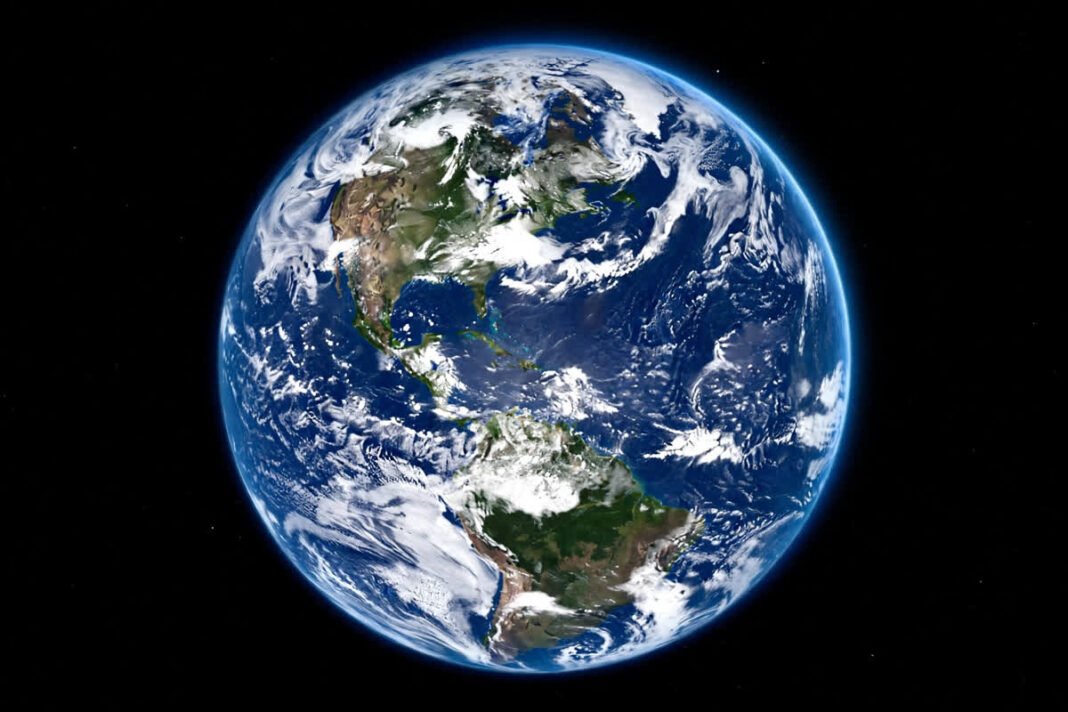

Earth is the only world we know that has oceans, oxygen and life — and it is still stranger than most of the planets we write about. These fun facts about Earth cover a core as hot as the surface of the Sun, a mountain trench deep enough to swallow Everest, and a planet that is quietly gaining weight from space dust every single year.
Some of these numbers have been updated for 2026, and a few of them correct things the rest of the internet still gets wrong — including a world heat record that stood for 90 years before scientists threw it out.
Below are 60 fun facts about Earth in six themed groups: the planet in space, what is happening deep inside it, its wild weather, its oceans, the life it carries, and how it stacks up against the other planets. First, the basics in a table.
Fun Facts About Earth: Quick Facts
| Quick Fact | Detail |
|---|---|
| Position from the Sun | 3rd planet |
| Planet type | Rocky (terrestrial) |
| Diameter | 12,742 km |
| Age | About 4.54 billion years |
| Distance from the Sun | About 149.6 million km (1 AU) |
| One day | 23 hours, 56 minutes (sidereal) |
| One year | 365.25 days |
| Axial tilt | 23.5 degrees |
| Moons | 1 (the Moon) |
| Surface covered by water | About 71% |
| Atmosphere | 78% nitrogen, 21% oxygen |
| Gravity | 9.8 m/s² (1 g) |
Earth in Space
Our fun facts about Earth start with the basics of our home in the solar system — a middle-aged, slightly squashed, very fast-moving ball of rock.
1. Earth Is the Only Planet Not Named After a God
Every other planet takes its name from Roman or Greek mythology — Mars, Venus, Jupiter, Mercury. Earth is the exception. Its name simply comes from old English and Germanic words for “the ground.” We named every world in the sky after gods, then called our own home “dirt.”
2. Earth Is About 4.54 Billion Years Old
Scientists dated meteorites and the oldest Earth rocks to pin our planet’s age at roughly 4.54 billion years, give or take about 50 million. For the first several hundred million of those years, the surface was largely molten, hammered by asteroids and hot enough that no life could exist.
3. You Are Travelling at 67,000 Miles per Hour Right Now
Earth orbits the Sun at an average speed of about 107,226 kilometres per hour (67,000 mph) — roughly 30 kilometres every second. In other words, you have travelled about 2.6 million kilometres around the Sun since yesterday — and you did not feel a thing.
4. A True Earth Day Is Not 24 Hours
Measured against the distant stars, Earth spins once in 23 hours, 56 minutes and 4 seconds. That is the sidereal day. The familiar 24-hour day is measured against the Sun, and it is slightly longer because Earth has moved along its orbit in the meantime. Even stranger: the spin is slowing down. The Moon’s gravity drags on Earth like a brake, lengthening our day by roughly 2 milliseconds every century.
5. Earth’s 23.5-Degree Tilt Gives Us the Seasons
Earth’s axis leans at about 23.5 degrees, probably knocked sideways by an ancient collision. That tilt — not our distance from the Sun — is why we have seasons. In June the northern half leans toward the Sun and gets summer, while the southern half leans away into winter. In fact, Earth is closest to the Sun in early January, in the middle of the northern winter.
6. Earth Is the Densest Planet in the Solar System
With an average density of about 5.5 grams per cubic centimetre, Earth packs more matter into every volume than any other planet — denser than Mercury, Venus, and far denser than the gas giants. Saturn, by comparison, is less dense than water. Earth’s density comes from its huge iron-nickel core, the largest core relative to planet size in the solar system.
7. Earth Is Not a Perfect Sphere
Spin a ball of rock for 4.5 billion years and it bulges in the middle. Earth’s equatorial circumference is about 40,075 kilometres, while its polar circumference is roughly 40,008 kilometres — the planet is about 43 kilometres wider across the equator than it is tall. As a result, if you stand on the equator, you are measurably farther from the centre than someone at the North Pole.
8. Earth Is the Largest Rocky Planet
Of the four terrestrial planets — Mercury, Venus, Earth and Mars — Earth is the biggest, at 12,742 kilometres across. Venus comes close at about 95% of Earth’s size, but Mars is only about half as wide, and Mercury barely a third. Everything larger than Earth in our solar system is a gas or ice giant with no solid surface to stand on.
9. Sunlight Left the Sun 8 Minutes Ago
Light travels at about 300,000 kilometres per second, and Earth sits roughly 149.6 million kilometres from the Sun — so the sunshine warming your face right now left the Sun’s surface about 8 minutes and 20 seconds ago. If the Sun vanished, we would not know for a full eight minutes.
10. Earth Sits in the “Goldilocks Zone”
Earth orbits in the narrow band around the Sun where temperatures are just right for liquid water to exist on the surface — not so hot that oceans boil away, as on Venus, and not so cold that they freeze solid, as on Mars. That lucky position is the foundation of everything alive on this planet.
Inside Earth
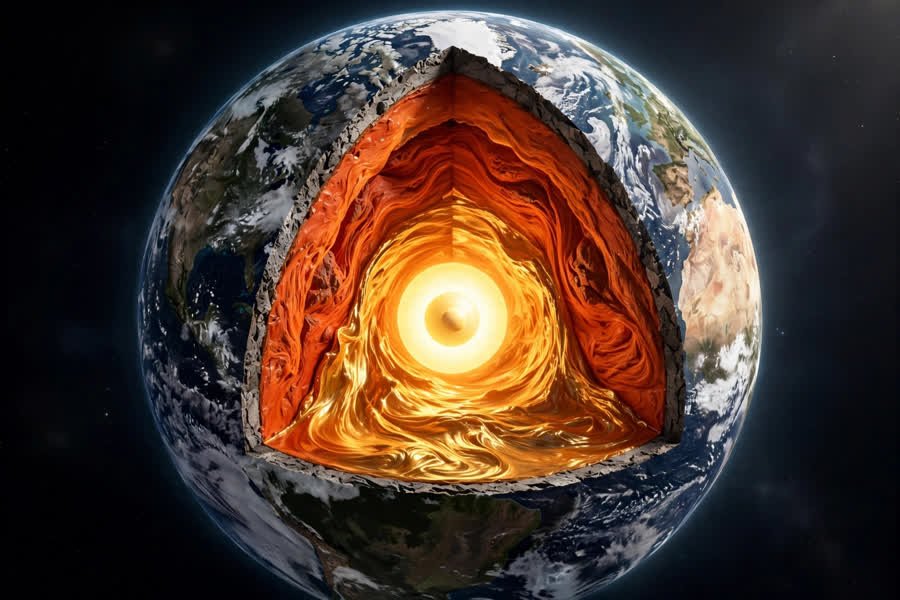
Some of the strangest fun facts about Earth are hidden beneath your feet, in a world no human has ever seen directly — the deepest hole ever drilled barely scratches it. Here is what scientists have pieced together about the inside of our planet.
11. Earth’s Core Is as Hot as the Surface of the Sun
The solid inner core at Earth’s centre reaches around 5,500 degrees Celsius — roughly the same temperature as the visible surface of the Sun. It stays solid despite that heat because the pressure there is more than 3 million times the pressure at the surface, crushing the iron and nickel into a solid ball.
12. The Inner Core Is a Moon-Sized Ball of Metal
Earth’s inner core is about 2,440 kilometres across — roughly 70% the size of the Moon — and made mostly of iron mixed with nickel. Around it churns the liquid outer core, another 2,200 kilometres thick. Together they account for about a third of the entire planet’s mass.
13. The Core Is Slowly Growing
Earth is very slowly cooling from the inside, and as it cools, liquid iron freezes onto the inner core. The solid core grows by roughly a millimetre every year — about the thickness of a credit card. As a result, over roughly a billion years it has added hundreds of kilometres to its width.
14. The Crust Is Thinner Than an Apple Skin
The rocky crust we live on is astonishingly thin compared with the planet. Under the oceans it can be just 5 to 10 kilometres thick; under the continents, 30 to 70 kilometres. If Earth were an apple, the crust would be thinner than the apple’s skin — and everything you have ever seen sits on that skin.
15. Continents Move as Fast as Your Fingernails Grow
The crust is broken into tectonic plates that creep along at about 2 to 5 centimetres a year — roughly the speed your fingernails grow. It sounds like nothing. But over 200 million years, that creep tore one supercontinent, Pangaea, into the map we know today. And it is still moving — the Atlantic Ocean widens by a few centimetres every year.
16. Earth’s Magnetic Field Is Made by a Liquid Metal Ocean
The swirling liquid iron in the outer core works like a giant generator, producing the magnetic field that surrounds the planet. That field deflects the solar wind — a constant stream of charged particles from the Sun. Mars, for example, lost most of its atmosphere after its own magnetic field died billions of years ago. Earth’s shield, in contrast, is a big reason our air and oceans are still here.
17. The Magnetic Poles Have Flipped — and Will Again
Earth’s magnetic field has reversed completely many times in the past: north becomes south and south becomes north. The last full flip happened about 780,000 years ago, and the field is currently weakening and wandering — the north magnetic pole is racing toward Siberia at tens of kilometres per year. A flip takes thousands of years, so it is a slow geological event, not a sudden disaster.
18. The Deepest Hole Ever Drilled Barely Scratched the Planet
The Kola Superdeep Borehole in Russia reached 12,262 metres down before heat and pressure stopped the drilling in the 1990s. It remains the deepest humans have ever gone — and it covers less than 0.2% of the distance to Earth’s centre. Everything we know about the deep interior comes from earthquake waves, not from going there.
19. Half of Earth’s Heat Is Radioactive
About half the heat escaping from Earth’s interior is leftover warmth from the planet’s violent formation 4.5 billion years ago. The other half is generated fresh by radioactive elements — uranium, thorium and potassium — slowly decaying in the mantle and crust. In effect, our planet is half cooling ember, half nuclear reactor.
20. There Is Enough Gold in the Core to Coat the Planet
When Earth was young and molten, most of its gold sank with the iron into the core. Geologists estimate there is enough gold locked down there to cover the entire surface of the planet in a layer about half a metre thick. In contrast, the gold we mine today is only the tiny fraction that stayed near the surface — or arrived later on asteroids.
Atmosphere and Weather
These fun facts about Earth turn to its thin blanket of air, which produces everything from gentle rain to the most violent weather in the inner solar system. These are its record books.
21. We Breathe the Minority Gas
The air around you is about 78% nitrogen and only 21% oxygen, with traces of argon, carbon dioxide and other gases making up the rest. Nitrogen is chemically quiet — it mostly just fills space — while the oxygen fifth of the atmosphere is the part that keeps every animal on Earth, including you, alive.
22. Oxygen Exists Because Life Put It There
For roughly the first half of Earth’s history, the air held almost no free oxygen. Then, about 2.4 billion years ago, cyanobacteria in the oceans began photosynthesising in earnest and exhaling oxygen as waste — an event called the Great Oxidation. The gas that was poison to most life then is the gas we cannot live without now.
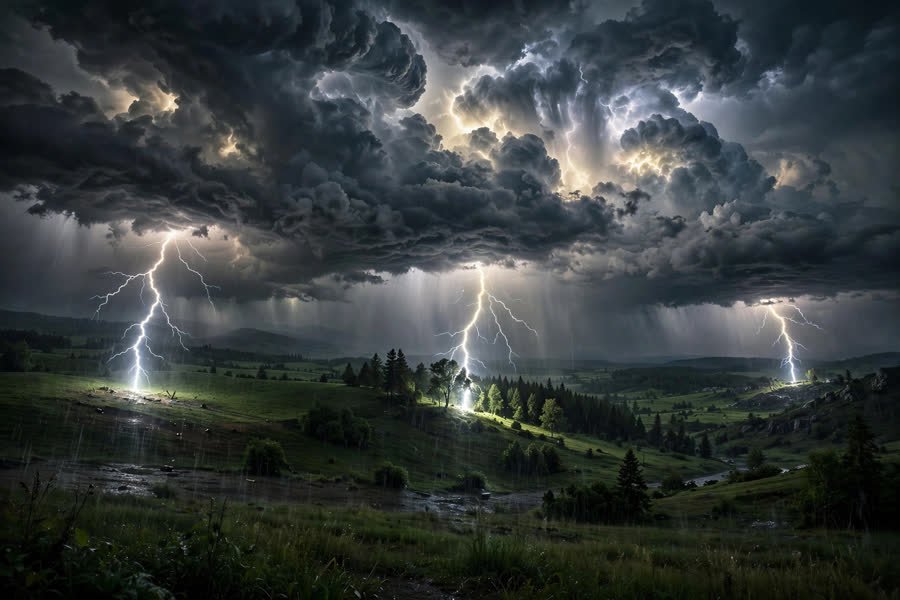
23. Lightning Strikes Earth About 100 Times Every Second
At any given moment, around 2,000 thunderstorms are active somewhere on the planet, and together they produce roughly 100 lightning bolts per second — more than 8 million strikes a day. A single bolt heats the air around it to about 30,000 degrees Celsius, roughly five times hotter than the surface of the Sun.
24. The Hottest Temperature Ever Recorded: 56.7 Degrees
The official world heat record is 134 degrees Fahrenheit (56.7°C), measured at Furnace Creek Ranch in California’s Death Valley on 10 July 1913. Moreover, Death Valley is a below-sea-level desert basin where sinking air compresses and heats. In short, it is the perfect natural oven. More than a century later, the World Meteorological Organization still stands by that reading as the highest surface air temperature ever reliably recorded.
25. The Coldest Temperature Ever Recorded: Minus 89.2 Degrees
At the other extreme, the Vostok research station in Antarctica recorded −128.6 degrees Fahrenheit (−89.2°C) on 21 July 1983 — the coldest natural air temperature ever measured on Earth. At that cold, exposed skin freezes in seconds and steel can become brittle enough to shatter. Satellites have since spotted even colder pockets on the high Antarctic plateau, but Vostok’s remains the official surface record.
26. A Fake Heat Record Stood for 90 Years
Many websites still claim Libya holds the heat record with 136 degrees Fahrenheit (57.8°C) at El Azizia in 1922. That reading stood as the official record for 90 years. Then, in 2012, a World Meteorological Organization investigation found it was likely wrong by several degrees. The observer was inexperienced, and the thermometer sat over asphalt-like ground. The WMO threw it out and restored Death Valley’s 1913 record. It is a good reminder that even “world records” need checking.
27. The Fastest Wind on Earth Topped 480 Kilometres per Hour
The highest wind speed ever measured on Earth — 302 miles per hour (486 km/h) — ripped through a tornado near Bridge Creek, Oklahoma, on 3 May 1999. It was clocked by a mobile Doppler radar truck chasing the storm. Winds like that do not just knock buildings down; they can drive straw through wood and strip pavement from roads.
28. The Wettest Place on Earth Gets 11 Metres of Rain a Year
The village of Mawsynram in northeastern India averages about 11.9 metres (roughly 39 feet) of rain every year, making it the wettest inhabited place on the planet. Moist air from the Bay of Bengal slams into the Khasi Hills and dumps its water almost all at once, most of it during the summer monsoon. Locals traditionally carry full-body umbrellas woven from bamboo and banana leaves.
29. Earth Gains Tons of Space Dust Every Year
Our planet is constantly sweeping up material as it orbits: tens of thousands of tons of cosmic dust and tiny meteoroids rain down through the atmosphere every year, most of it burning up or settling invisibly. At the same time, Earth slowly loses hydrogen and helium gas leaking into space from the top of the atmosphere — so on balance, our planet is very gradually getting lighter, not heavier.
30. The Atmosphere Has No Edge
There is no line where air stops and space begins. The atmosphere just gets thinner and thinner — the International Space Station, orbiting about 400 kilometres up, still brushes enough air molecules that it needs regular boosts to avoid being dragged down. The commonly used “edge of space,” the Kármán line at 100 kilometres, is a human convention, not a physical boundary.
Oceans and Water
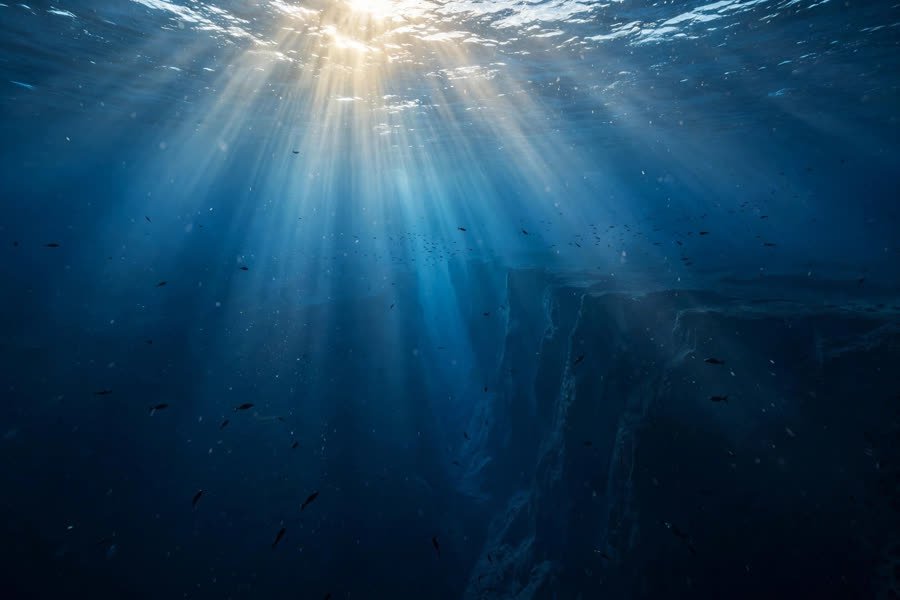
From space, Earth is not green or brown — it is blue. These fun facts about Earth dive into the oceans, which dominate the planet’s surface, its geology, and even its relationship with the Moon.
31. Oceans Hold 96.5% of All Earth’s Water
About 71% of Earth’s surface is covered by water, and almost all of it is one connected world ocean. Of all the water on the planet, roughly 96.5% sits in the oceans. Every river, lake, glacier, cloud and glass of water you have ever seen comes out of the remaining few percent.
32. The Deepest Point on Earth Is Deeper Than Everest Is Tall
The Challenger Deep, at the southern end of the Mariana Trench in the Pacific, plunges about 10,935 metres below sea level — the deepest known point on the planet. Mount Everest rises 8,849 metres above sea level. Measure the trench against the mountain and the ocean wins by more than 2 kilometres.
33. Everest Would Drown in the Mariana Trench
Here is the same fact the fun way: if you picked up Mount Everest and dropped it into the Challenger Deep, the summit would still sit more than a kilometre underwater. Only a handful of humans have ever been down there. Fewer people have visited the bottom of the trench than have walked on the Moon.
34. The Longest Mountain Range on Earth Is Underwater
The mid-ocean ridge system snakes about 65,000 kilometres through every ocean basin — a mountain range longer than the Andes, the Rockies and the Himalayas combined, almost entirely hidden beneath the sea. In fact, it marks where tectonic plates are pulling apart and new ocean floor is being born.
35. The World’s Biggest Waterfall Is Under the Ocean
The Denmark Strait cataract, between Greenland and Iceland, drops cold Arctic water about 3.5 kilometres down into the Atlantic — more than three times the height of Angel Falls, the tallest waterfall on land. It carries an enormous flow of water, and almost nobody has heard of it, because the entire thing happens beneath the surface of the sea.
36. More Than 80% of the Ocean Is Still Unexplored
We have detailed maps of the Moon and Mars, but by NOAA’s estimate, more than 80% of Earth’s ocean remains unmapped, unobserved and unexplored. The deep sea is dark, crushing and expensive to reach — which is why scientists sometimes joke that we know the surface of the Moon better than our own seabed.
37. The Moon Is Drifting Away From Us
Laser reflectors left on the Moon by Apollo astronauts let scientists measure the distance precisely — and the Moon is moving away from Earth at about 3.8 centimetres per year. The Moon’s gravity drags on our oceans and creates the tides. That friction slowly transfers Earth’s spin energy to the Moon, pushing it outward. Hundreds of millions of years ago, the Moon was much closer and the tides were far stronger. A day on Earth lasted well under 24 hours.
38. Earth’s Water Probably Came From Space
The early Earth was likely too hot to hold onto its own water. The leading theory is that our oceans were delivered later by water-rich asteroids bombarding the young planet — the chemical fingerprint of Earth’s water closely matches the water locked inside a class of meteorites called carbonaceous chondrites. In a real sense, every ocean on Earth is alien.
39. The Largest Living Structure on Earth Is a Reef
Australia’s Great Barrier Reef stretches over 2,300 kilometres and is built by billions of tiny coral polyps — the largest structure on the planet made by living organisms. Moreover, it is not one reef but around 3,000 individual reefs and 900 islands, supporting roughly 1,500 species of fish.
40. The Highest Tides on Earth Rise Like a Building
In Canada’s Bay of Fundy, the tide can rise and fall by about 16 metres — roughly the height of a five-storey building — twice a day. The bay’s shape funnels the Atlantic’s tidal push into an ever-narrower, shallower channel, amplifying it. Around 160 billion tonnes of water move in and out with each cycle, more than the combined flow of all the world’s freshwater rivers.
Life on Earth
The next fun facts about Earth are about its passengers: Earth is the only place in the universe where life is known to exist — and the life here is weirder, older and more numerous than most people realise.
41. Earth Is the Only Known Living Planet
Thousands of planets have been discovered around other stars, and a few sit in their stars’ habitable zones. But so far, Earth remains the only world where life is actually confirmed to exist. In fact, life appeared here surprisingly early — evidence suggests microbes were already thriving within the planet’s first billion years.
42. Scientists Estimate 8.7 Million Species — Most Still Undiscovered
A widely cited 2011 study estimated that Earth holds about 8.7 million species of complex life — and that roughly 86% of land species and 91% of ocean species have not even been discovered yet, let alone named. We have formally described only around 1.6 to 2 million. The age of discovery is not over; it has barely started.
43. There Are About 3 Trillion Trees on Earth
A major 2015 study counted Earth’s trees using satellite data and ground surveys. It landed on roughly 3 trillion. That is far more than earlier estimates — and hundreds of trees for every person alive. Even so, the same research found that humans cut down around 15 billion trees a year, and the total has fallen by nearly half since human civilisation began.
44. The Blue Whale Is the Largest Animal That Has Ever Lived
The blue whale grows to about 30 metres long and can weigh around 180 tonnes — larger than any dinosaur known. Its heart alone can weigh as much as a small car, and its tongue as much as an elephant. Nothing in the fossil record, not even the biggest sauropods, clearly beats it.
45. The Largest Organism on Earth Is a Fungus
In Oregon’s Malheur National Forest, a single honey fungus (Armillaria ostoyae) spreads through the soil and tree roots across about 9.6 square kilometres — one connected organism, genetically identical throughout, and thousands of years old. Most of it, however, is underground; the mushrooms that pop up after rain are just its fruit.
46. Tardigrades Have Survived Open Space
Tardigrades — microscopic animals nicknamed water bears — are the toughest creatures known. In a 2007 European Space Agency experiment, tardigrades exposed directly to the vacuum and radiation of open space for ten days came back to life when rehydrated. They have also survived being frozen, boiled, dried out for years and crushed under extreme pressure.
47. Some Living Trees Were Old When Rome Fell
Great Basin bristlecone pines in California’s White Mountains are the oldest known non-clonal trees on Earth. One named tree, Methuselah, has been growing for roughly 4,850 years — it was already ancient when the Roman Empire collapsed, and it is still alive today. Therefore, its exact location is kept secret to protect it.
48. There Are About 20 Quadrillion Ants on Earth
A 2022 scientific estimate put the global ant population at roughly 20 quadrillion. That is 20 million billion ants — about 2.5 million ants for every human on the planet. Together they are thought to weigh more than all wild birds and wild mammals combined.
49. You Share About 60% of Your Genes With a Banana
It sounds like a joke, but it is real biology: around 60% of human genes have a recognisable counterpart in the banana genome. That is because all complex life shares ancient housekeeping genes for basic cell functions inherited from a common ancestor billions of years ago. You also share roughly 90% with a cat and about 98.8% with a chimpanzee.
50. Earth’s Human Population Passed 8 Billion in 2022
On 15 November 2022, the United Nations marked the “Day of Eight Billion” — the point at which Earth’s human population officially crossed 8 billion people. It took all of human history until around 1800 to reach the first billion, then just over 200 years to add seven more. Growth is now slowing, and the UN expects the population to peak later this century.
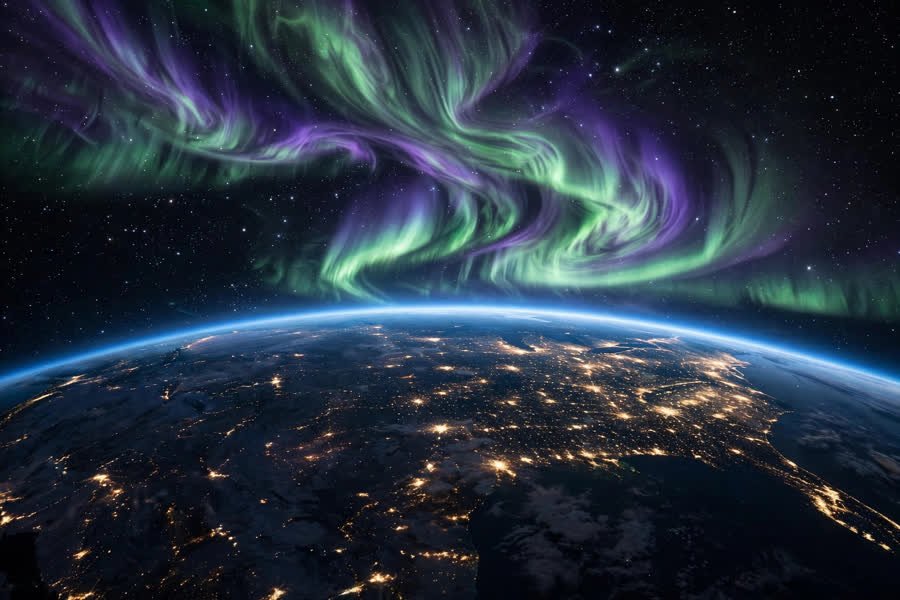
Earth vs. the Other Planets
Our final fun facts about Earth line it up against its neighbours — and in category after category, our planet is the odd one out.
51. Earth Is the Only Planet With Active Plate Tectonics
As far as scientists can tell, Earth is the only planet whose surface is currently broken into moving plates that grind, collide and recycle themselves. Mars shows the scars of ancient volcanoes and canyons but its crust is one solid, stagnant shell today. Plate tectonics may be essential for life: it recycles carbon and keeps Earth’s climate stable over billions of years.
52. Our Moon Is Unusually Huge
The Moon is about 27% as wide as Earth — by far the largest moon relative to its planet among the eight planets. Most moons are tiny compared with their planets; ours is so big that Earth and the Moon are sometimes described as a double-planet system. It formed when a Mars-sized world called Theia smashed into the young Earth about 4.5 billion years ago, and debris from the collision clumped together in orbit.
53. Venus Spins Backwards — and Its Day Beats Its Year
Venus rotates the “wrong” way, and so slowly that one full spin takes 243 Earth days — longer than the 225 days Venus needs to orbit the Sun. Earth, by contrast, packs about 365 spins into every orbit. Consequently, if you stood on Venus (you could not, but imagine), the Sun would rise roughly once every 117 Earth days — and it would rise in the west.
54. Venus Is Hotter Than Mercury, Despite Being Farther From the Sun
Mercury is the closest planet to the Sun, yet Venus is hotter: its thick carbon-dioxide atmosphere traps heat in a runaway greenhouse effect, baking the surface at about 465 degrees Celsius day and night. Earth keeps the same kind of blanket — but far thinner and balanced by oceans and life. Venus is the solar system’s warning of what an atmosphere can do.
55. Jupiter Acts as Earth’s Shield
Jupiter‘s enormous gravity — more than twice the mass of all other planets combined — pulls in or deflects many comets and asteroids that might otherwise wander toward the inner solar system. In 1994, astronomers watched comet Shoemaker-Levy 9 slam into Jupiter in a series of fireballs instead of continuing sunward. Earth is not fully protected, but the giant next door takes a lot of hits for us.
56. Mars Is Rusty; Earth’s Iron Sank
Mars is red because its surface iron has literally rusted — oxidised into red dust that covers the planet. Earth started with plenty of iron too, but most of it sank into the core while the planet was molten, and what remained at the surface was buried, dissolved into oceans, or locked into rock by life itself. The two planets are a before-and-after of what iron does.
57. Earth Would Sink Fastest in a Cosmic Bathtub
Saturn is famous for being less dense than water — it would float. Earth sits at the opposite extreme: at about 5.5 grams per cubic centimetre, it is the densest planet of all, so in a big enough tub of water it would sink faster than any of its siblings. That density is the fingerprint of our giant metal heart.
58. Earth Is the Only Planet With Water in All Three States on Its Surface
On Earth’s surface, water exists naturally as a solid (ice), a liquid (oceans and rain) and a gas (water vapour) — often in the same place on the same day. In comparison, no other planet manages this. Mars has ice and vapour but no stable surface liquid; Venus boiled its water away; the outer planets lock theirs in deep-frozen shells.
59. Earth Is the Fastest-Spinning Rocky Planet
Among the four rocky planets, Earth spins the quickest: one rotation every 23 hours 56 minutes, against Mars at 24 hours 37 minutes, Mercury at 59 Earth days and Venus at 243. At the equator, the surface is moving at about 1,670 kilometres per hour — fast enough that rockets are launched eastward from near the equator to steal some of that speed for free.
60. From 6 Billion Kilometres Away, Earth Is a Single Pale Dot
On 14 February 1990, Voyager 1 turned its camera homeward from about 6 billion kilometres away. It took the most distant portrait of Earth ever made. Our entire planet — every ocean, continent and person — fits inside a single pale blue pixel, about 0.12 of a pixel wide, floating in a band of scattered light. It remains the best reminder of how small, and how special, this world is.
Earth is one stop on a much bigger tour — start with our guide to fun facts about space, then meet the neighbours in our facts about Mars and Jupiter.
Frequently Asked Questions
Earth is about 4.54 billion years old. Scientists worked this out by dating meteorites — leftover building blocks of the solar system — and the oldest rocks and minerals found on Earth itself, which agree on the same age.
Earth has one permanent moon — the Moon. Occasionally, a small asteroid gets temporarily captured by Earth’s gravity and orbits us for a few months as a “mini-moon” before drifting away; one about the size of a bus, asteroid 2024 PT5, did exactly that in late 2024.
Seasons come from Earth’s 23.5-degree axial tilt, not from our distance to the Sun. As Earth orbits, the tilt points each hemisphere toward the Sun in turn, giving it longer days and more direct sunlight — summer — while the other hemisphere gets winter. Earth is actually closest to the Sun in January.
So far as we know, Earth is the only planet with life because everything lined up at once: liquid water on the surface, a breathable atmosphere, a protective magnetic field, a stable climate over billions of years, and the right distance from its star. No other world we have studied checks all t
More Fun Facts About Earth: Your Questions
About 71% of Earth’s surface is covered by water, and roughly 96.5% of all the planet’s water is in the oceans. All lakes, rivers and glaciers together make up only a small slice of the rest.
No. Although new crust constantly forms at mid-ocean ridges, old crust sinks back into the mantle at subduction zones at about the same rate, so the planet’s size stays essentially constant. Earth does gain tens of thousands of tons of space dust a year, but it also loses gases to space, so the total barely changes.
Almost certainly, someday — the field has reversed hundreds of times in Earth’s history, most recently about 780,000 years ago. A reversal takes roughly 1,000 to 10,000 years to complete, during which the field weakens and the poles wander. It would be a long, strange transition for compasses and technology, not a sudden catastrophe.
Very fast, in three ways at once: the surface at the equator spins at about 1,670 kilometres per hour, Earth orbits the Sun at about 107,226 kilometres per hour, and the whole solar system is travelling around the centre of the Milky Way at roughly 828,000 kilometres per hour. You are moving at all three speeds right now — and feeling none of them.