


Mars is the planet everyone thinks they know, yet these fun facts about Mars reveal a world stranger than the red dot in the textbooks. It rusted while water still flowed — a 2025 study rewrote even its colour. It also holds the tallest volcano, the longest canyon and blue sunsets.
Robots still drive its deserts years after landing, and a small helicopter rewrote aviation history there. Meanwhile, pieces of Mars itself sit in museums on Earth, delivered free by ancient impacts.
Below are 35 fun facts about Mars in five themed groups — record landscapes, wild weather and failed missions. First, the basics in a table.
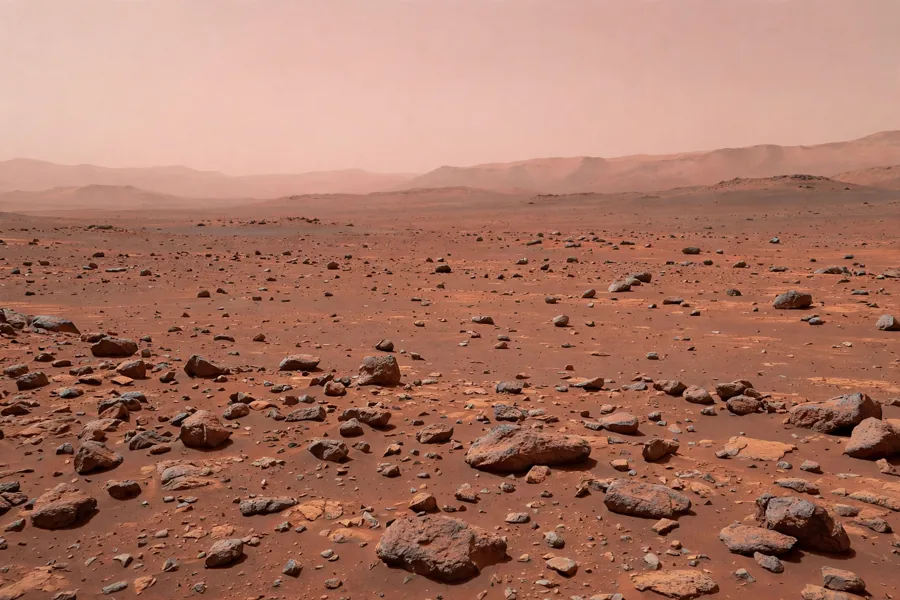
Mars Quick Facts
| Quick Fact | Detail |
|---|---|
| Position from the Sun | Fourth planet |
| Diameter | 6,779 km |
| Distance from the Sun | 227.9 million km |
| One day (a sol) | 24 hours, 37 minutes |
| One year | 687 Earth days (669.6 sols) |
| Average temperature | −63 °C |
| Temperature range | −153 °C to +20 °C |
| Moons | 2 — Phobos and Deimos |
| Gravity | 38% of Earth’s |
| Mass | About a tenth of Earth’s |
| Atmosphere | 95% carbon dioxide |
| Named after | The Roman god of war |
The Red Planet Next Door
Our fun facts about Mars start close to home — the colour, calendar and featherweight gravity of this odd neighbour.
1. Mars Rusted While It Was Still Wet
For decades, scientists blamed Mars’s red colour on dry rust, a mineral called hematite. However, a study published in February 2025 matched spacecraft data with laboratory-made dust. Instead, the dust’s main ingredient proved to be ferrihydrite, a rust that forms quickly only in cool water. So Mars rusted early, when lakes and rivers still covered parts of it.
2. Our Next-Door Neighbour Is Months Away
Mars, the fourth planet from the Sun, circles at an average of 227.9 million kilometres. Even so, its distance from Earth swings wildly, from about 54.6 million kilometres to over 400 million. Because of that, spacecraft can only launch in windows opening roughly every 26 months. Perseverance still cruised 203 days — our neighbour is a seven-month journey away.
3. A Sol Feels Familiar; the Year Drags
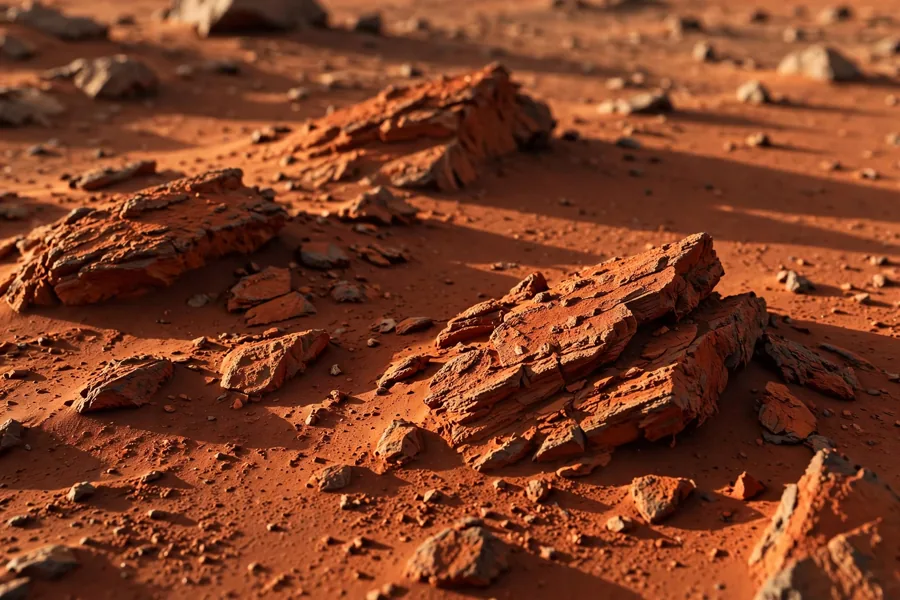
A single Martian day, called a sol, lasts 24 hours and 37 minutes. That is barely longer than an Earth day, so future visitors’ body clocks would cope surprisingly well. The year is another story, however: 687 Earth days, or 669.6 sols. As a result, seasons last almost twice as long as ours, and birthdays come around half as often.
4. Mars Has Its Own Calendar — Year 39
Planetary scientists count Mars years from 1955, starting each one at the northern spring equinox. Mars Year 39 began on 30 September 2026, so the planet is now in its 39th counted year. Meanwhile, mission teams plan rover seasons and winter shutdowns around this calendar. It is a working timetable, not a novelty: Mars time is how exploring gets scheduled.
5. On Mars You Weigh Just 38% as Much
Gravity on Mars pulls at only 38% of Earth’s strength. So a person who weighs 70 kilograms at home would register about 27 kilograms on Martian scales. Meanwhile, a 10-kilogram bag of supplies would feel like under four kilograms in your hands. Yet the bargain has a catch: over long stays, weak gravity lets bones and muscles slowly waste away.
6. Half Earth’s Width, but the Same Land Area
Mars measures 6,779 kilometres across — half Earth’s diameter — and holds barely a tenth of Earth’s mass. Yet it has no oceans to hide its surface under. As a result, its land area — roughly 144 million square kilometres — nearly matches Earth’s dry land. A whole planet of continents, then — with nothing living on them, as far as we know.
7. Named for War; Its Moons for Fear
The Romans named the blood-red planet after Mars, their god of war; the Greeks called the same god Ares. Fittingly, its moons carry the names of Ares’ twin sons, Phobos and Deimos — Fear and Panic, who rode into battle beside their father. The naming shaped language, too: “areo-“, from Ares, does for Mars exactly what “geo-” does for Earth.
The Biggest Landscapes in the Solar System
Next, our fun facts about Mars go big: tallest volcano, longest canyon, largest possible impact scar.
8. Olympus Mons Towers 22 Kilometres High
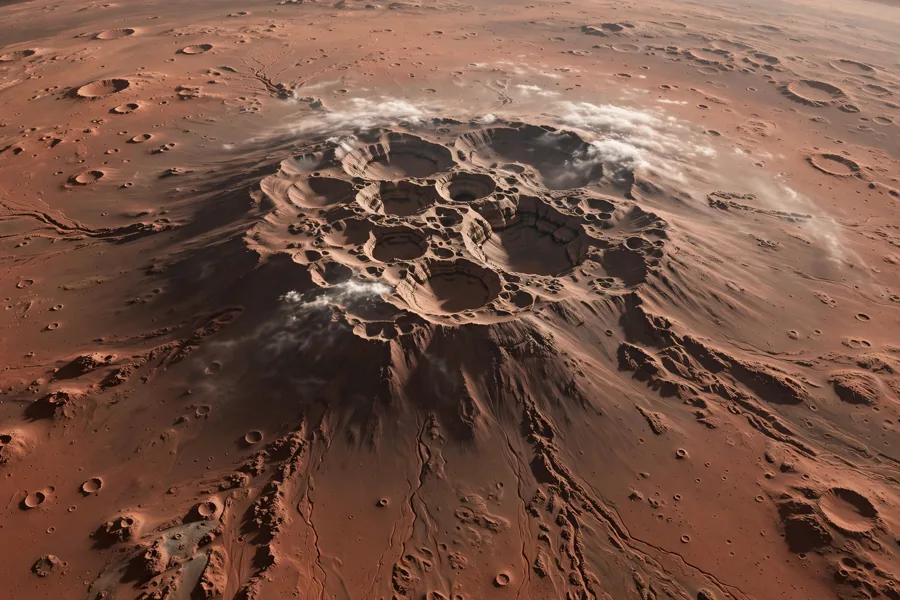
Olympus Mons is the tallest volcano in the solar system, about 22 kilometres above the plains around it. That is two and a half times Mount Everest’s height. Its base sprawls 600 kilometres wide — France-sized — topped by an 80-kilometre caldera. It grew so huge because Mars has no moving plates, so lava just piled onto one spot.
9. A Canyon That Would Cross America
Valles Marineris stretches 4,000 kilometres along the equator — New York to Los Angeles, roughly. In places it yawns 200 kilometres wide and some seven kilometres deep, dwarfing the Grand Canyon. However, no river carved it: the crust ripped open as a volcanic bulge swelled, and erosion widened it later. It honours Mariner 9, which revealed it in 1971.
10. One Impact Scooped Out 40% of Mars
Any map of Mars splits the planet in two: smooth low northern plains, rugged southern highlands. Scientists think one colossal impact explains this divide — a basin covering about 40% of the surface. The culprit, wider than Pluto, struck some 4.5 billion years ago. If confirmed, this Borealis Basin is easily the largest impact scar in the whole solar system.
11. Marsquakes: A Planet Creaking as It Cools
NASA’s InSight lander spent four years listening to Mars with a sensitive seismometer. It recorded more than 1,300 marsquakes, mostly from the crust cracking as the planet slowly cools and shrinks. The biggest, in May 2022, was about magnitude five — the largest quake ever detected on another world. Mars has no moving plates, so its rumblings come from cooling.
12. A Liquid Heart in a Quiet Planet
Seismic waves from InSight revealed a large liquid iron-alloy core at Mars’s centre, roughly half the planet’s radius across. Yet Mars has gone quiet: that liquid metal no longer churns into a global magnetic field. Nor is there any sign of modern volcanoes or geothermal activity. So the metal heart survives — it simply stopped driving the planet’s machinery long ago.
13. Jezero Crater Once Held a Lake Like Tahoe
More than 3.5 billion years ago, a river fed a lake inside Jezero Crater, building a delta of mud and sediment. That is why NASA landed Perseverance there in 2021. The rover’s photographs of layered delta cliffs then confirmed the ancient lake beyond doubt. In 2026, its ground-penetrating radar found a second, older delta buried beneath the first.
14. Pieces of Mars Rain Down on Earth for Free
Impacts sometimes blast Martian rocks into space; some eventually fall to Earth as meteorites. Scientists identify them by gas trapped inside, which matches the Martian air Viking measured. The official Meteoritical Bulletin Database lists 392 confirmed Martian specimens, yet only five were ever seen falling. The largest single piece, found in 2023, weighs about 24.7 kilograms.
Sky, Air and Wild Weather
More fun facts about Mars appear when you look up: the wrong-coloured sky, and weather that can swallow a planet.
15. Pink Days — and Blue Sunsets
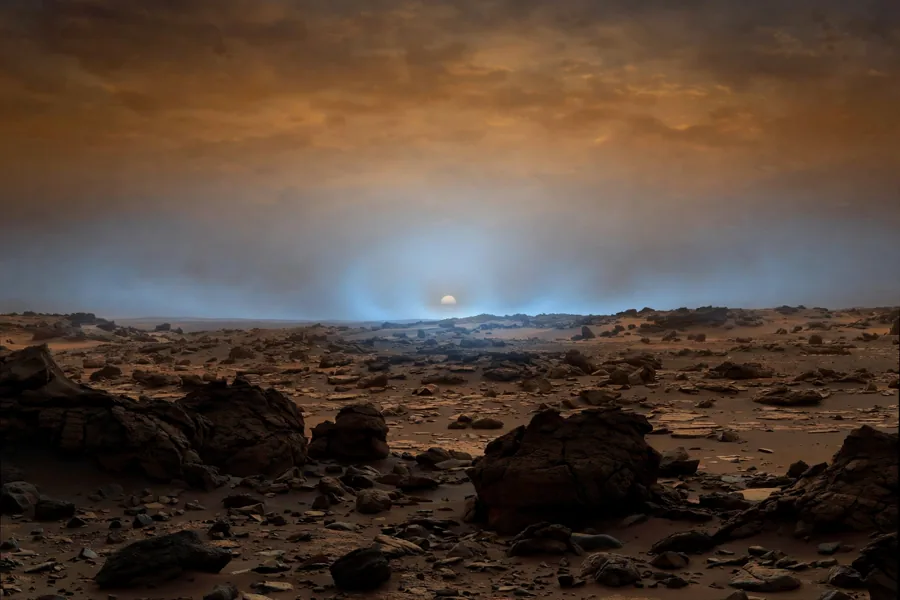
Rusty dust hangs in the Martian air and scatters red light everywhere, so the daytime sky glows butterscotch-pink. Around the setting Sun, however, the effect flips, because blue light slips through the dust more efficiently there. As a result, sunsets on Mars glow blue-grey — the exact reverse of Earth’s. Curiosity filmed one in 2015; Perseverance watches the same show.
16. Air Too Thin to Breathe, and Poisonous Besides
Mars’s atmosphere is about 95% carbon dioxide, with only traces of oxygen — nothing a human could breathe. Worse, it is vanishingly thin, pressing down with less than 1% of Earth’s surface pressure. That sits below the Armstrong limit, where water boils at body temperature. So the air fails twice: nothing to inhale, and too little pressure on your body.
17. Dust Devils That Tower Over 10 Kilometres Tall
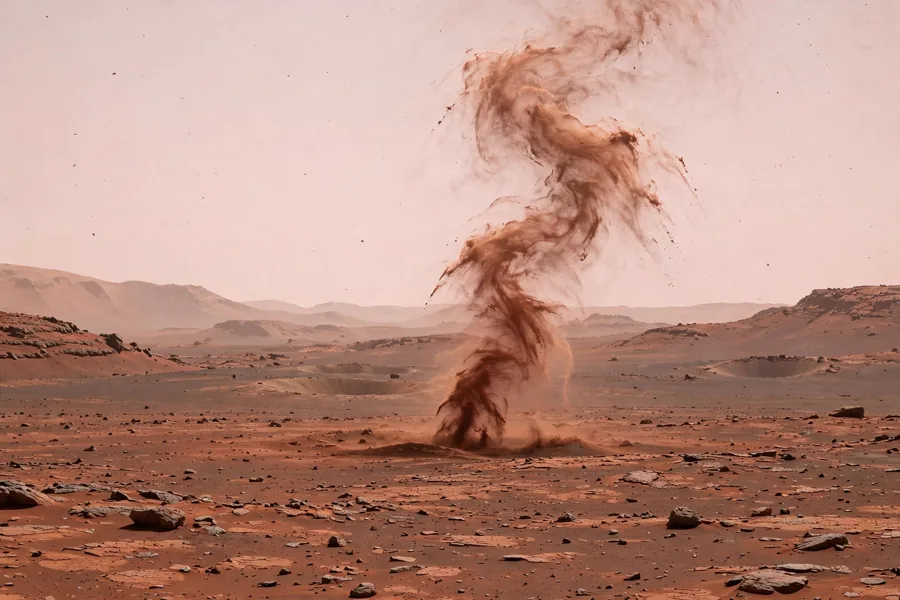
Dust devils spin across Mars as they do in Earth’s deserts, but on a monstrous scale. Martian ones routinely tower past 10 kilometres, and orbiters photographed one plume in 2012 estimated at 20 kilometres high. Their tracks streak whole regions in dark and light ribbons, visible from space. Rovers have filmed them marching past like slow tornadoes.
18. Storms That Swallow the Whole Planet
Dust storms flare up in southern spring and summer; some grow until they wrap the planet in haze. Global storms were recorded in 2001, 2007 and 2018, roughly every three Mars years. At their peak, daylight dims to twilight for months. Yet the winds feel feeble — the air is too thin to push hard. Darkness and dust are the real dangers.
19. The 2018 Storm That Ended Opportunity
Opportunity landed in 2004, designed to last just 90 Martian days. Instead, it kept roving for over 5,000 days and drove 45.16 kilometres. Then the 2018 global storm blotted out its sunlight, and daily power crashed from 667 watt-hours to about 22. Its last transmission arrived on 10 June 2018, and NASA formally declared the mission over the following February.
20. “Spiders” Carved by Bursting Dry Ice
Near the south pole, branching dark channels sprawl like spiders, some over a kilometre wide. No animal makes them, despite the nickname. Each winter a dry-ice slab settles over the pole; spring sun warms the soil beneath, and trapped gas builds until it cracks. Erupting gas blasts dark sand into fan shapes, scouring the spider patterns underneath.
21. Auroras Can Glow Anywhere on Mars
Earth channels auroras to its poles, but Mars has no global magnetic field to guide the solar wind. Only fossil magnetic patches survive, frozen into old southern rocks. So charged particles strike the air directly, and auroras can appear anywhere on the night side. In 2024–25, Perseverance photographed a green aurora from the surface — a glow future astronauts may watch.
Moons, Missions and the Great Galactic Ghoul
Our fun facts about Mars now turn to two odd moons and the spacecraft braving the trip — half never arrive.
22. Phobos Rises in the West
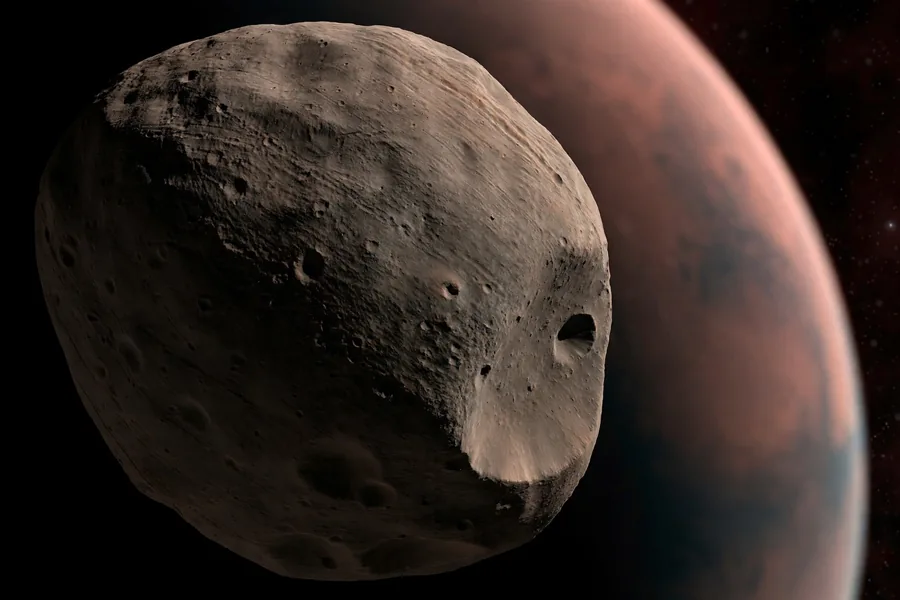
Phobos circles Mars in just 7 hours and 39 minutes, faster than the planet itself rotates. So from the surface, this moon rises in the west and races eastwards, crossing the sky twice a Martian day — impossible on Earth. It hugs Mars just 6,000 kilometres above the equator — the closest-orbiting moon known around any planet.
23. Phobos Is Doomed to Become a Ring
Tides are dragging Phobos inwards by about 1.8 metres every century. In roughly 30 to 50 million years, Mars’s gravity will pull harder than the little moon can hold together. Most models say it will then shred into a ring of debris, briefly giving Mars a Saturn-style halo. Grooves across its cratered surface may already be the first stress cracks.
24. Two Potato Moons, Found in 1877
Both moons are small, dark lumps of rubble: Phobos measures about 22 kilometres across, Deimos only about 12. Astronomer Asaph Hall spotted them in August 1877, during a close Mars approach, using a leading telescope of the age. He found Deimos first, then Phobos six days later. Japan’s MMX mission, launched in 2026, aims to bring Phobos material home.
25. The “Great Galactic Ghoul” Guards Mars
Since 1960, agencies have launched 50-plus missions to Mars, and only about half fully succeeded. Losses run from early Soviet failures to Mars Climate Orbiter (1999), killed by an imperial–metric mix-up. Engineers joke that a spacecraft-eating monster, the Great Galactic Ghoul, guards the planet jealously. Still, the record since 2000 is far better — the Ghoul mostly ate the pioneers.
26. Ingenuity Flew 72 Times on a Five-Flight Ticket
The Ingenuity helicopter arrived as a small experiment, meant to fly at most five times in 30 days. Instead, after its first flight in April 2021 — the first powered flight on another world — it kept going for almost three years. It logged 72 flights and 17 kilometres, scouting ahead of Perseverance. Rotor damage ended it in January 2024.
27. Two Rovers Still Drive on Mars Today
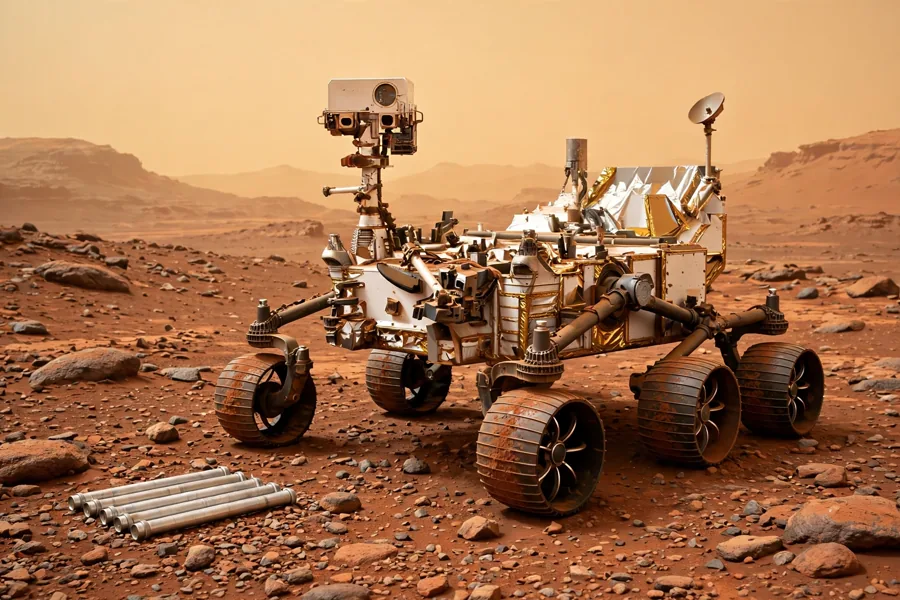
Right now, only two rovers are active on Mars, and both belong to NASA. Curiosity has explored Gale Crater since 2012, while Perseverance has worked Jezero Crater since 2021. Both run on nuclear power, so dust cannot starve them of sunlight as it killed their solar-powered cousins. Above them, orbiters from several nations still circle.
28. Zhurong Slept in 2022 and Never Woke
China’s Zhurong rover landed in May 2021, making China the second nation to run a Mars rover. It drove 1,921 metres — four times its planned life — before hibernating for winter in May 2022. It was expected to wake that December, but it never did. Dust on its solar panels is the likely cause; it remains silent, presumed lost.
Could We Ever Live There?
Finally, our fun facts about Mars ask the biggest question: could people live there?
29. We Have Already Made Oxygen on Mars
Inside Perseverance sits MOXIE, a toaster-sized device that splits carbon dioxide drawn from the Martian air. In April 2021 it made five grams of oxygen — the first resource manufactured on another planet. Across 16 runs it made 122 grams in total, at its best rate doubling its design goal. Crews would need one a hundred times larger.
30. A Rock Called Cheyava Falls Holds a Clue
In July 2024, Perseverance drilled a core from a rock nicknamed Cheyava Falls. In September 2025, NASA announced a potential biosignature in it: spotted, iron-rich mineral patterns alongside organic carbon in old lake sediment. That phrase needs care: the chemistry might have a biological origin — nothing more. Ordinary chemistry is not ruled out; only Earth laboratories can settle it.
31. The Sample-Fetching Mission Was Cancelled
Perseverance has sealed its samples in tubes, ten of them deposited at a depot on the surface. The NASA–ESA mission meant to fetch them was cancelled in 2026, after cost estimates climbed towards 11 billion dollars. NASA is studying simpler, cheaper options, but none is announced or funded. So the most interesting rocks ever collected still sit on Mars, waiting.
32. Water on Mars Right Now — Almost All Frozen
Mars is not the bone-dry world it first seemed. Its polar caps together hold about 2.5 million cubic kilometres of water ice — comparable to Greenland’s ice sheet. Radar has also found huge glaciers buried at mid-latitudes, plus ice just beneath many surfaces. Liquid water, however, cannot survive on the surface today; exposed, it would freeze and boil away at once.
33. The Polar Caps Breathe With the Seasons
Both poles wear permanent caps of water ice, and each winter something strange happens on top of them. Roughly a third of the entire atmosphere freezes out as carbon-dioxide snow onto the winter pole. Then spring sunlight turns that dry ice straight back into gas, swelling the air again. In the south, this cycle drives the bursting geysers behind the “spiders”.
34. Earth-Like Tilt, Lopsided Seasons
Mars leans at 25.2 degrees, close to Earth’s tilt, so it enjoys proper spring, summer, autumn and winter. However, its stretched orbit puts southern summers nearest the Sun, making them shorter and hotter than northern ones. That imbalance helps fire up each southern spring’s dust-storm season. Each season lasts nearly twice ours, because the year is so long.
35. You Can Watch Mars Growing Brighter Right Now
Through late 2026, Mars shines in the morning sky, brightening monthly as Earth catches up. It reaches opposition on 19 February 2027, rising at sunset and glowing all night. This opposition will be modest, since Mars is then near its far point. Even so, it is the finest Mars viewing until 2029 — worth stepping outside for.
Why Mars Still Surprises Scientists
Mars keeps rewriting its own story: rust that formed in water, samples awaiting a rescue no longer funded, blue sunsets under a pink noon sky. If these fun facts about Mars have whetted your appetite, our collection of fun facts about space covers the whole solar system. And for the swift world that matches Mars for gravity, try our fun facts about Mercury.
The story unfolds still: two rovers drive on, radar redraws the water map, and February 2027 brings opposition. For mission news, NASA’s Mars page and ESA’s Mars Express page are the sources to watch. Expect some of these fun facts about Mars to be sharpened, or overturned, within years.
Fun Facts About Mars — Frequently Asked Questions
Still curious? Here are short answers to the questions these fun facts about Mars raise most.
About seven months, on the fuel-efficient paths missions fly. Perseverance cruised 203 days; NASA quotes seven to ten months depending on the window. The catch is timing: Earth and Mars line up favourably only every 26 months. Crewed ships face the same physics: six to nine months each way.
About 38% of your Earth weight, because Martian gravity pulls at just 0.38 g. So 50 kilograms becomes roughly 19, and 70 kilograms about 27. Your mass stays the same — only gravity’s grip changes. You could jump two and a half times higher than on Earth, spacesuit permitting.
You would not explode, but you would be in mortal danger within seconds. The air holds no oxygen: consciousness goes in about 15 seconds. Meanwhile, pressure below the Armstrong limit means moisture on your eyes, mouth and skin boils at body temperature, and tissues swell. Suffocation strikes first — a suit here is a personal spacecraft, not clothing.
Yes — as ice, and plenty of it: the polar caps hold about 2.5 million cubic kilometres, with more buried as glaciers and frost. Stable surface liquid is another matter: cold, thin air makes it freeze and boil away. The reported underground “lake” is now doubted, after 2025 radar favoured buried rock instead.
More Mars Questions, Answered
Honestly, nobody knows: no date is fixed, and no crewed mission is funded yet. NASA’s goal is the 2030s, once its Artemis Moon programme proves the systems. SpaceX talks of uncrewed cargo landings from 2028, but those are company targets, not booked flights. The fair summary: the 2030s at the earliest, and on paper only.
Mars stacks every hard problem at once. A seven-month cruise gives faults time to strand a craft, and 22-minute radio delays force fully automatic landings. The air is the worst middle ground — thick enough to scorch a craft, too thin for parachutes. Add power-killing dust and human error — one orbiter died over mixed-up units.
Look east before dawn through late 2026: Mars is a steady, non-twinkling orange-red “star” in Leo, brightening monthly. The best moment is its opposition on 19 February 2027, when it rises at sunset and shines all night at magnitude −1.2. There is no opposition in 2026. A small telescope then shows its disc and polar cap.
It is falling, but a single crash is probably the wrong ending. Phobos sinks 1.8 metres per century; in 30 to 50 million years, Mars’s tides will overpower its weak gravity. Models favour it shredding into a debris ring that rains down slowly. Either way, Phobos ends as craters — and Mars briefly wears a ring.