
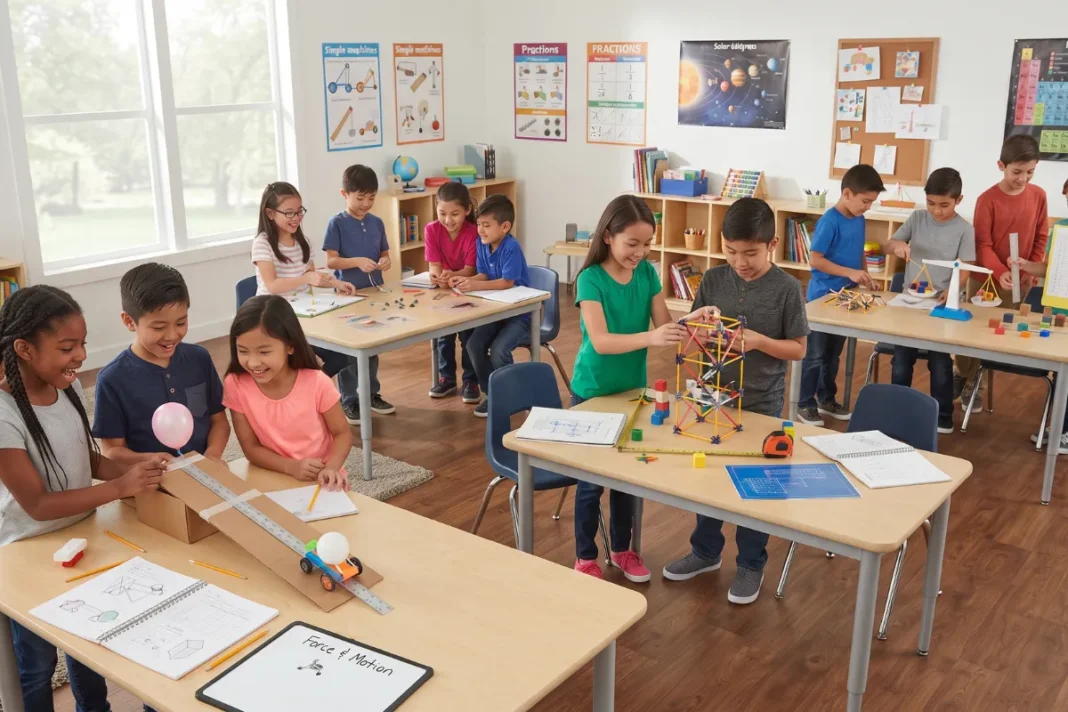

A cross curricular focus physical science approach helps students understand science by connecting physical science concepts with math, English language arts, art, engineering, technology, and everyday activities. Instead of learning force, motion, gravity, friction, or magnetism as isolated topics, students can explore these ideas through different subjects and real-world experiences.
This approach can make science lessons more engaging because students use what they already know in new ways. For example, a motion experiment can become a math activity when students measure distance and time, an ELA activity when they write about their observations, and an engineering challenge when they design a better solution.
The Next Generation Science Standards also connects forces and motion with investigation, measurement, ELA, mathematics, and engineering practices. For Grade 3, students investigate balanced and unbalanced forces, observe motion patterns, and explore electric and magnetic interactions.
What Is Cross Curricular Focus Physical Science?
Cross curricular focus physical science means teaching physical science concepts through connections with other school subjects.
Physical science generally explores matter, energy, forces, motion, electricity, magnetism, and interactions between objects. When teachers connect these concepts with other areas, students can see how science works beyond a traditional science lesson.
For instance, students might:
- Measure how far a toy car travels.
- Record motion data in a table.
- Calculate differences between measurements.
- Write an explanation of the experiment.
- Draw a picture showing force and motion.
- Design a small vehicle using engineering ideas.
- Research how transportation has changed over time.
These activities turn one science concept into a broader learning experience.
Why Does Cross-Curricular Learning Matter?
Students rarely use only one skill when solving a real-world problem. They may need to read instructions, measure objects, analyze information, communicate an idea, and create a solution.
Cross-curricular learning reflects this process.
It also gives students more than one way to understand a difficult concept. A child who struggles with a textbook explanation of friction may understand it quickly after testing a toy car on carpet, cardboard, and a smooth floor.
Benefits of Integrated Physical Science Activities
A well-planned cross-curricular lesson can help students develop:
- Scientific thinking
- Measurement skills
- Observation skills
- Mathematical reasoning
- Communication skills
- Reading and writing skills
- Problem-solving abilities
- Creativity
- Engineering thinking
- Collaboration
- Data analysis
Therefore, a cross-curricular approach can support both science knowledge and broader academic skills.
Math and Physical Science Activities
Math is one of the easiest subjects to connect with physical science because many science investigations involve measurement, counting, comparison, and data.
Measure Force and Motion
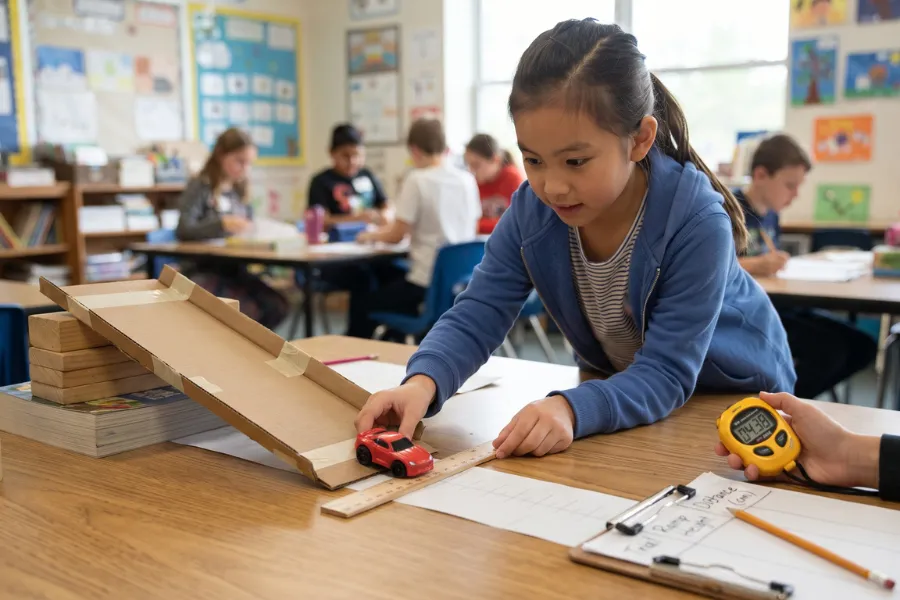
Give students a toy car, ramp, ruler, and stopwatch. Ask them to investigate how far the car travels from different starting points.
Students can record:
- Starting height
- Distance traveled
- Time
- Surface type
- Number of trials
They can then compare the results.
At an elementary level, the goal does not need to be complicated physics calculations. Students can focus on observing patterns and using measurements as evidence.
The NGSS Grade 3 standards specifically include observing and measuring motion to identify patterns that can help predict future motion.
Create a Motion Data Chart
Students can make a simple table showing how far an object travels during several trials.
For example:
| Trial | Distance | Time | Surface |
|---|---|---|---|
| 1 | 40 cm | 3 sec | Cardboard |
| 2 | 55 cm | 3 sec | Smooth floor |
| 3 | 32 cm | 3 sec | Carpet |
Afterward, ask students what they notice.
This activity combines science observation with mathematical organization and comparison.
Explore Fractions and Measurement
Students can divide a measured distance into equal sections.
For example, if a toy car travels 100 centimeters, students can identify:
- 1/2 of the distance
- 1/4 of the distance
- 3/4 of the distance
This creates a simple connection between fractions and physical movement.
ELA and Physical Science

English language arts can strengthen science learning because students need to explain what they observe and support their ideas with evidence.
Build a Physical Science Vocabulary
Create a classroom vocabulary wall with words such as:
- Force
- Motion
- Gravity
- Friction
- Magnetism
- Energy
- Mass
- Speed
- Push
- Pull
- Balanced force
- Unbalanced force
Students can write definitions in their own words and use each term in a sentence.
Write an Experiment Explanation
After completing an investigation, students can write a short explanation using this structure:
Question → Prediction → Procedure → Observation → Result → Explanation
For example:
We wanted to find out which surface created more friction. We tested a toy car on carpet and cardboard. The car traveled a shorter distance on carpet. This suggests that the carpet created more resistance to the car’s motion.
This activity connects scientific investigation with writing.
NGSS also identifies ELA connections for Grade 3 forces and motion, including research and writing activities.
Read About Scientists
Students can research scientists associated with physical science, such as Isaac Newton, and create short reports about their discoveries.
Instead of simply memorizing facts, encourage students to explain how scientific ideas changed the way people understand motion and forces.
Social Studies and Physical Science
History and social studies can provide another meaningful connection.
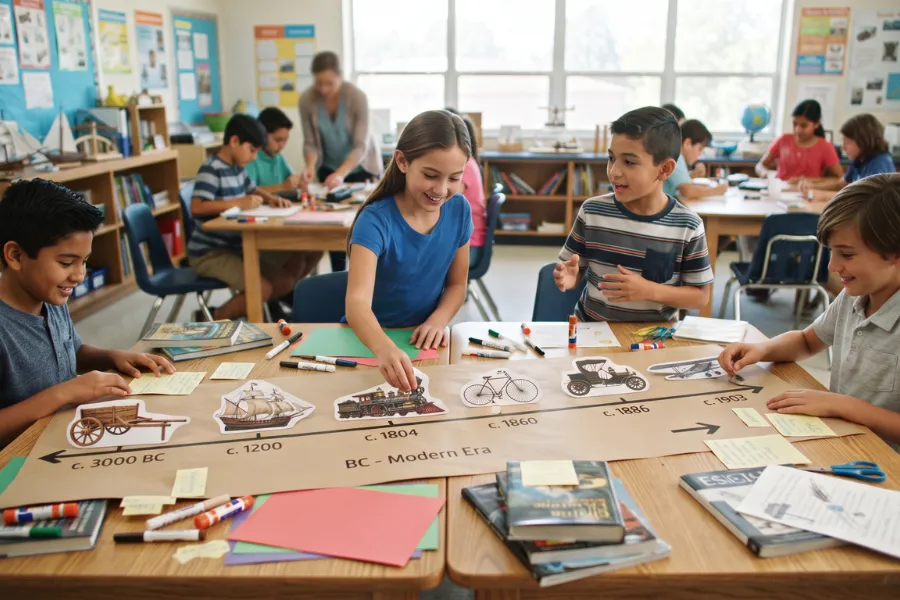
Create a Science History Timeline
Students can create a timeline showing important developments in transportation and technology.
Possible examples include:
- Early carts
- Sailing ships
- Steam engines
- Bicycles
- Automobiles
- Airplanes
- Electric vehicles
Students can investigate how changes in science and engineering affected transportation.
Explore the History of Transportation
Ask students why vehicles need wheels, why brakes create friction, and how engines or motors create motion.
This gives students an opportunity to connect historical development with physical science concepts.
Art and Physical Science
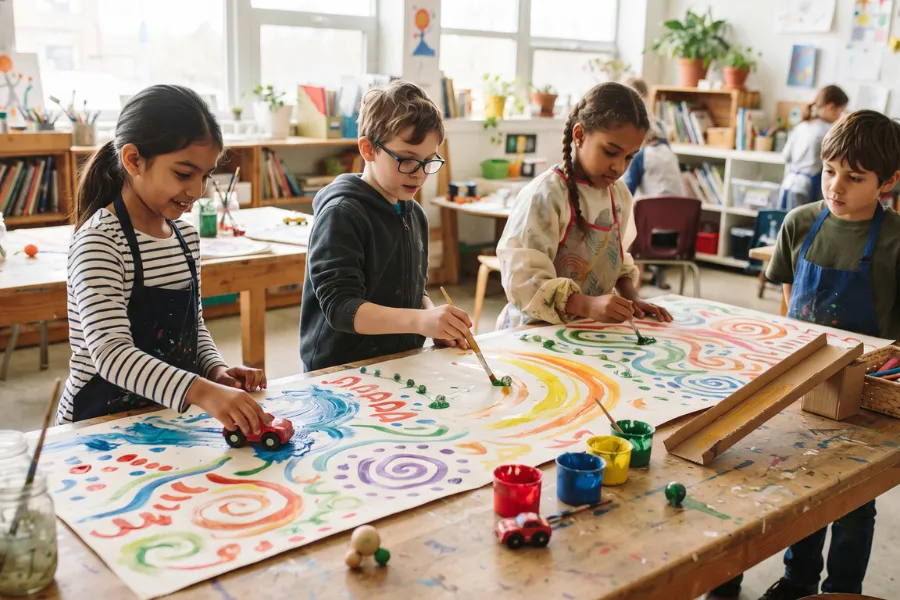
Art can make abstract science concepts visible.
Create Motion Art
Students can create artwork that represents movement.
They might draw:
- A rolling ball
- A moving car
- A flying bird
- A swinging object
- A spinning wheel
Ask them to use lines, shapes, and repeated patterns to show direction and motion.
Gravity Art Experiment
Give students washable paint and paper. Let them carefully observe what happens when paint moves downward because of gravity.
They can compare:
- Thick and thin paint
- Different paper angles
- Different amounts of paint
Then ask them to explain how gravity affected the movement.
This combines observation, creativity, and physical science.
Engineering and Physical Science
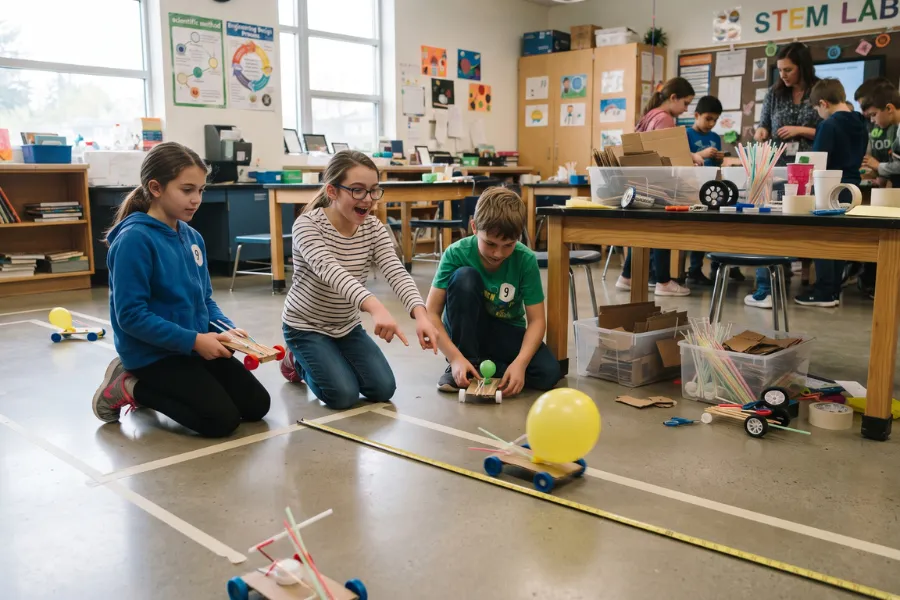
Engineering activities are particularly useful because students can apply science concepts to solve a problem.
Build a Balloon-Powered Racer
Students can create a small vehicle using simple classroom materials.
The challenge is simple:
Can you build a vehicle that moves forward when powered by air from a balloon?
Students can test different designs and compare their results.
They can change:
- Wheel size
- Vehicle weight
- Axle design
- Balloon position
- Body shape
After testing, students can identify which design worked better and explain why.
Design a Friction Investigation
Give students several materials and ask them to determine which surface makes a toy car travel the shortest distance.
Possible surfaces include:
- Carpet
- Paper
- Cardboard
- Fabric
- Smooth plastic
Students should make a prediction before testing. Then they can collect data, compare results, and explain their findings.
This follows the general investigation-and-evidence approach emphasized in the Grade 3 NGSS forces and motion expectations.
Physical Education and Physical Science
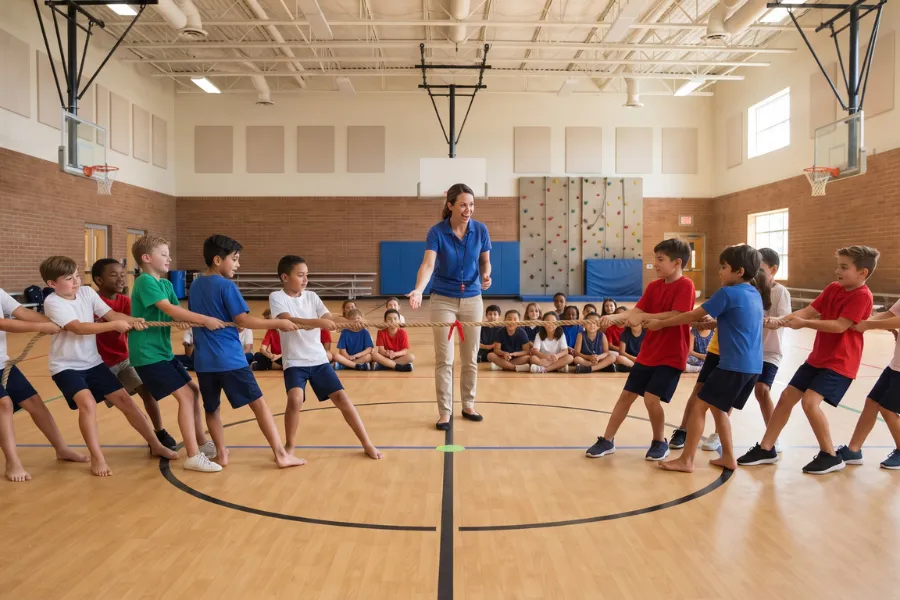
Movement provides a natural way to demonstrate physical science.
Explore Balanced and Unbalanced Forces
A simple tug-of-war demonstration can help students visualize balanced and unbalanced forces.
When two sides pull with similar strength in opposite directions, the rope may remain nearly stationary. When one side produces a greater pull, the rope moves.
This gives students a physical example of how forces can affect motion.
For Grade 3, NGSS describes balanced and unbalanced forces as part of the forces and interactions topic.
Study Motion Through Sports
Students can observe motion during activities such as:
- Running
- Jumping
- Throwing
- Kicking
- Cycling
- Catching
Ask questions such as:
What caused the object to move?
What changed its direction?
Where did friction occur?
How did the surface affect movement?
These questions help students connect everyday movement with science.
Technology and Physical Science
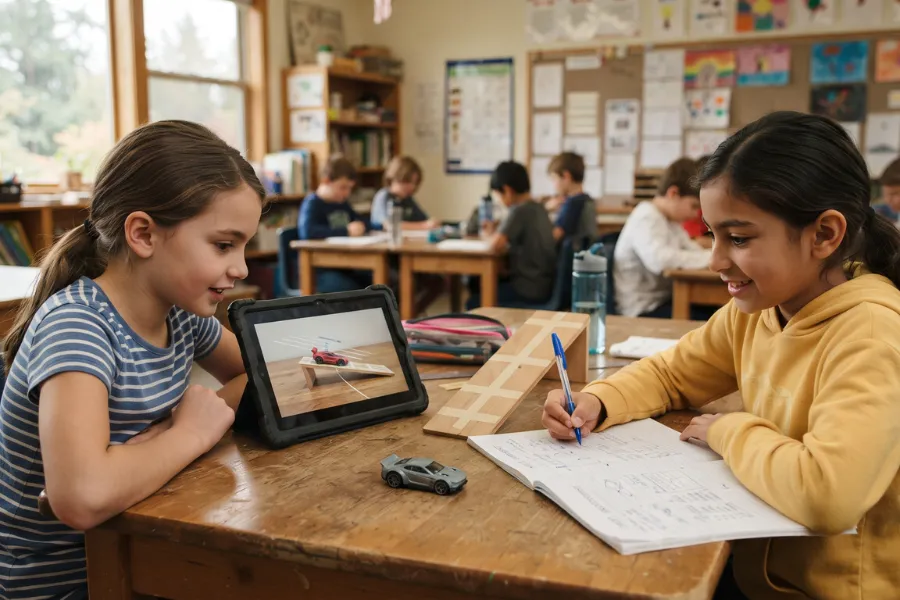
Technology can help students collect, present, and analyze information.
Create a Digital Science Presentation
Students can make a short presentation about one physical science concept.
Possible topics include:
- Gravity
- Friction
- Magnetism
- Force
- Motion
- Energy
They can include images, diagrams, observations, and a short explanation.
Analyze Motion With Video
Students can record a simple experiment and watch the video afterward.
For example, they could record a toy car moving down a ramp.
Then they can identify:
- Starting position
- Direction of motion
- Changes in speed
- Distance traveled
- Factors affecting movement
Technology therefore becomes a tool for observation rather than just entertainment.
Hands-On Cross Curricular Focus Physical Science Activities
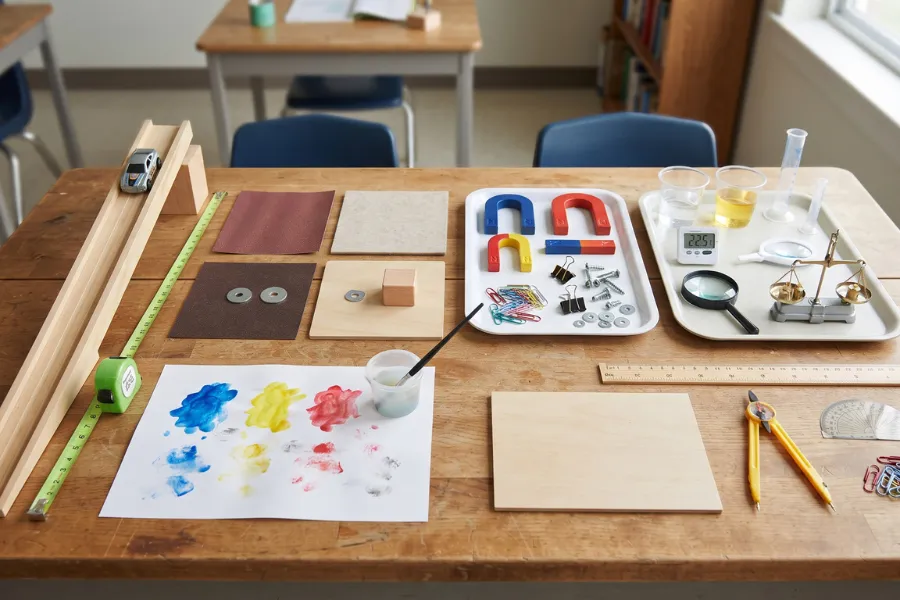
Hands-on investigations can make physical science concepts easier to understand.
1. Toy Car and Ramp Challenge
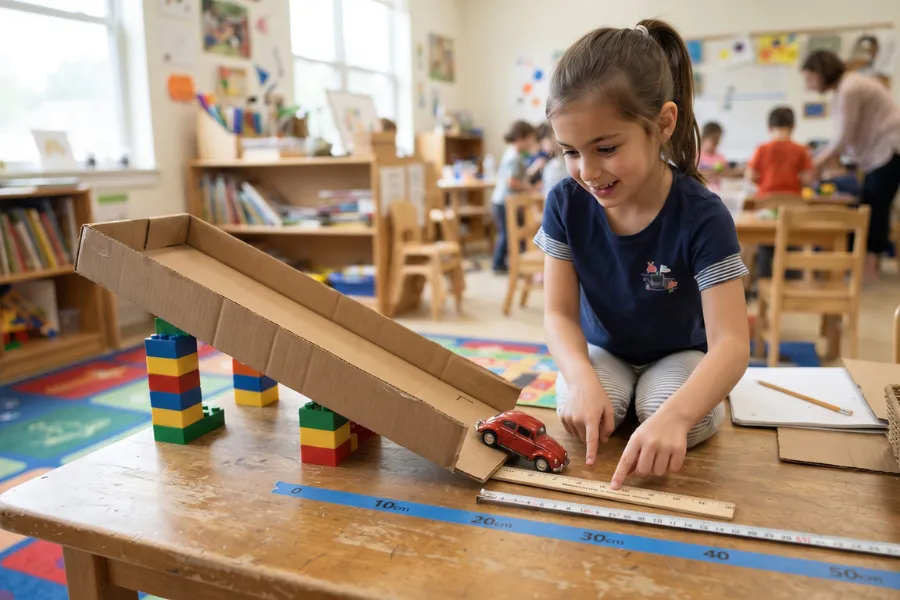
Build a simple ramp using cardboard or a book.
Change the starting height and observe how the car’s motion changes.
Students can measure the distance traveled and repeat the experiment several times.
2. Magnet and Paper Clip Investigation
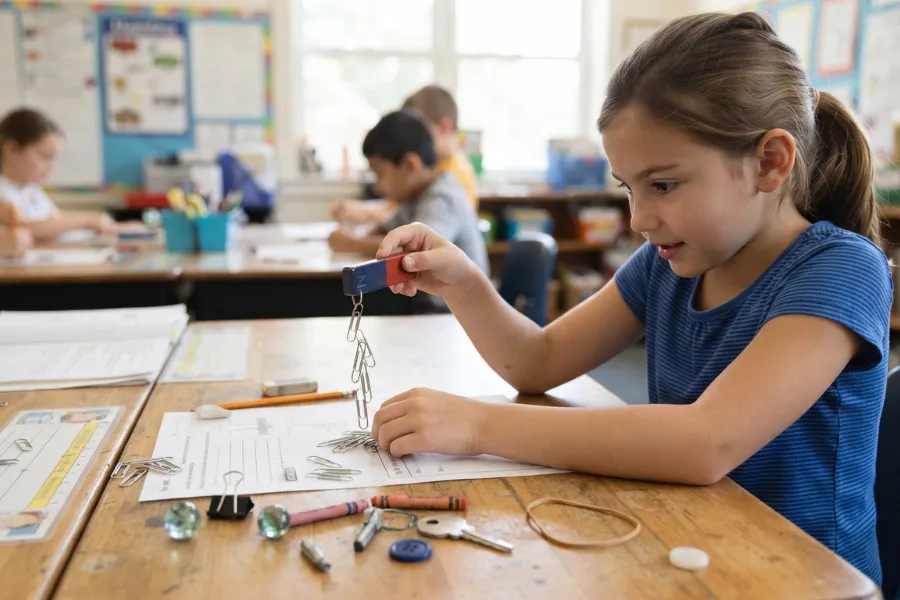
Give students a magnet and several objects.
Ask them to predict which objects will respond to the magnet.
Then let them test their predictions.
Students can organize the results into two groups:
Magnetic and Not Magnetic
This activity introduces magnetic interactions through direct observation. NGSS includes magnetic interactions as part of Grade 3 forces and interactions.
3. Simple Compass Investigation
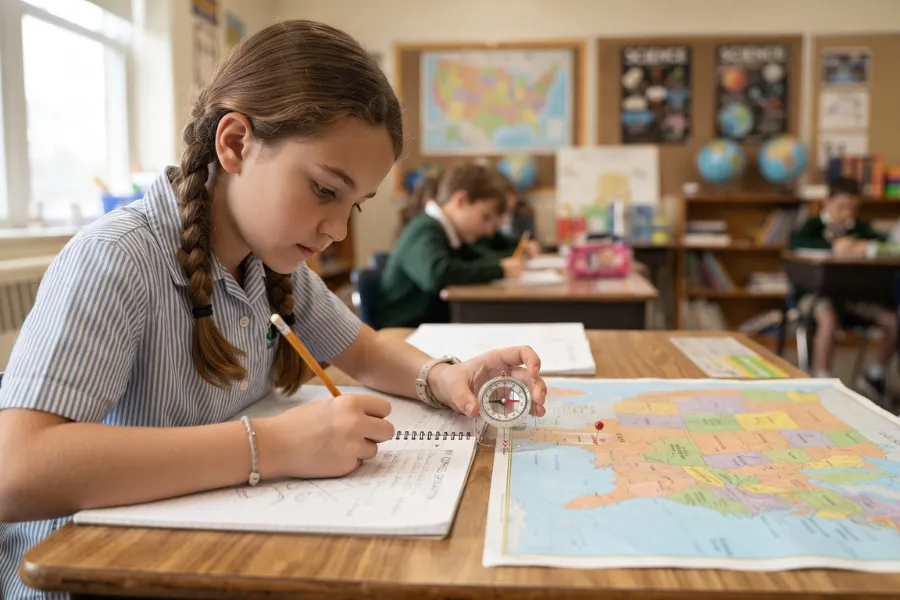
Students can explore how a compass helps identify direction.
They can compare the compass direction with a classroom map or outdoor location.
This activity connects magnetism with geography.
4. Friction Surface Test
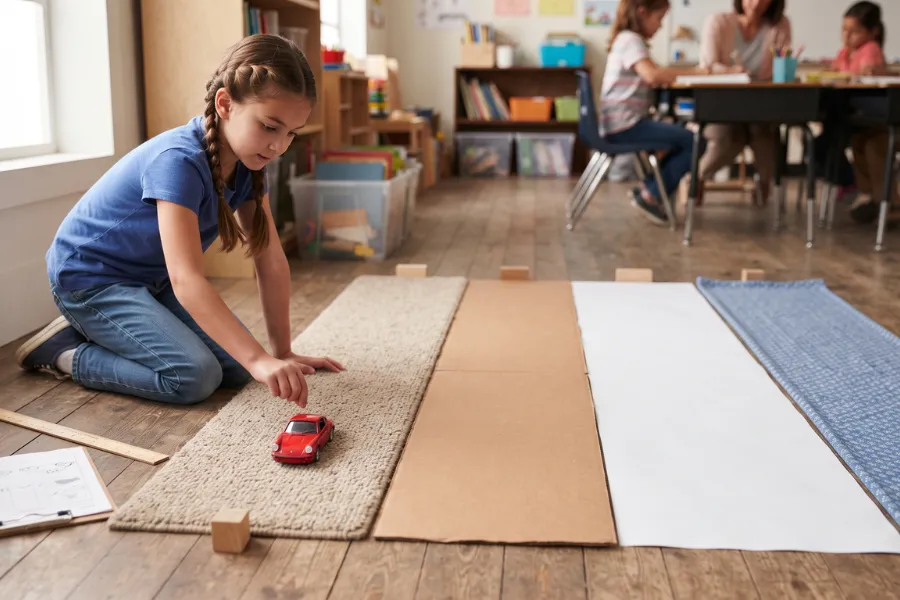
Place the same toy car on different surfaces.
Keep the starting point the same and measure how far the car travels.
Ask students:
Which surface allowed the car to travel farther?
Which surface created more resistance?
What evidence supports your answer?
5. Motion Painting
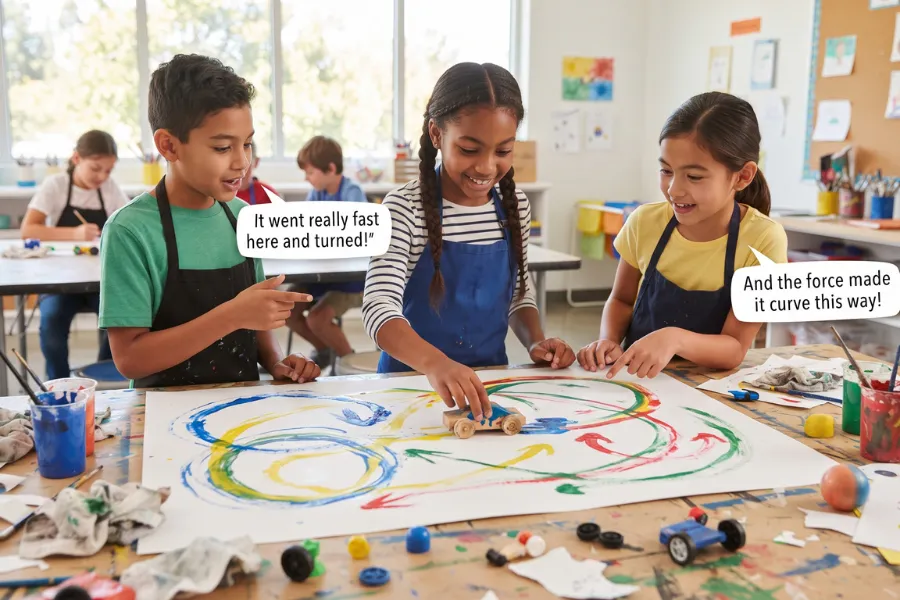
Students can create art while observing movement.
For example, they can move a paint-covered object across paper and observe the trail.
Then they can describe the movement using science vocabulary such as direction, force, motion, and speed.
Physical Science Concepts to Explore
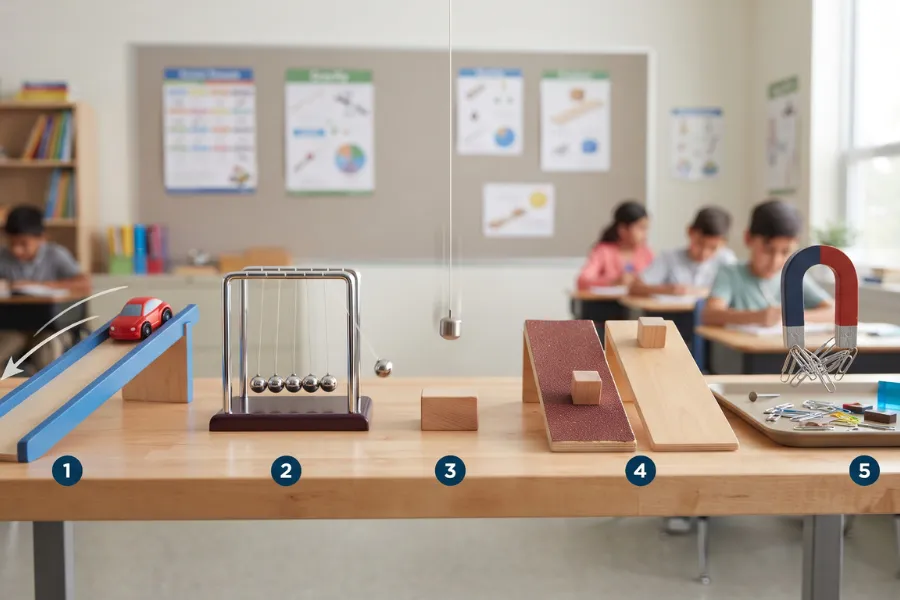
A strong cross curricular focus physical science lesson should still maintain a clear science objective.
The other subjects should support the science concept rather than distract from it.
Force and Motion
Force is a push or pull that can affect an object’s motion.
Students can investigate force by pushing, pulling, rolling, or throwing objects.
Balanced and Unbalanced Forces
Balanced forces can result in no change in motion, while unbalanced forces can cause changes in an object’s speed or direction. At the Grade 3 level, these ideas are taught conceptually rather than through advanced quantitative calculations.
Gravity
Gravity pulls objects toward Earth.
Students can observe its effects by dropping objects, watching objects fall, or exploring how gravity affects the movement of a ball.
Friction
Friction is a force that resists motion between surfaces.
Students can explore friction by comparing smooth and rough surfaces.
Magnetism
Magnets can attract or repel certain objects or interact with other magnets without direct contact.
A paper clip and magnet investigation provides a simple introduction to magnetic forces.
Patterns of Motion
Motion can sometimes follow predictable patterns.
For example, a swinging object or a ball moving back and forth can demonstrate repeated movement. Students can observe the pattern and use their observations to make predictions.
How to Plan a Cross-Curricular Physical Science Lesson
Planning becomes easier when teachers follow a simple sequence.
Choose One Physical Science Concept
Start with one clear concept such as force, motion, friction, gravity, or magnetism.
Avoid trying to teach too many science ideas during one activity.
Select a Connected Subject
Next, choose the subject that naturally supports the science goal.
For example:
- Math → measurement and data
- ELA → reading and explanation
- Art → visual representation
- Engineering → design challenge
- Social studies → history and technology
- Geography → direction and mapping
- PE → movement and forces
Create a Hands-On Activity
Whenever possible, let students observe something directly.
A short experiment can provide evidence that students can later measure, discuss, write about, or illustrate.
Let Students Explain Their Results
Do not stop after the experiment.
Ask students:
- What happened?
- Why do you think it happened?
- What evidence did you collect?
- What would happen if we changed one variable?
- How could you improve the experiment?
Assess What Students Learned
Assessment does not always need to be a test.
Students can demonstrate understanding through:
- A science journal
- A labeled diagram
- A data table
- A short paragraph
- A presentation
- A model
- An engineering design
- An oral explanation
Cross Curricular Physical Science by Grade Level
The difficulty of an activity should match the students’ age and learning goals.
Grade 3 Physical Science Activities
Grade 3 students can explore:
- Balanced and unbalanced forces
- Motion patterns
- Gravity
- Magnets
- Simple electric interactions
- Measurement
- Data collection
- Basic engineering design
The NGSS Grade 3 forces and interactions standards specifically include investigations of forces, motion patterns, electric and magnetic interactions, and simple design problems.
Grade 4 Physical Science Activities
Older students can work with more detailed measurements, energy connections, and increasingly complex explanations.
Teachers can introduce more challenging data analysis and engineering problems as appropriate for their curriculum.
Grade 5 Physical Science Activities
Students can build on earlier concepts by examining more complex interactions and using evidence to explain physical phenomena.
The exact activity should depend on the curriculum and learning standards used by the school.
Tips for Teachers and Parents
A successful cross curricular focus physical science activity does not need expensive equipment.
Try these practical tips:
- Start with everyday objects. Use toy cars, balls, paper, magnets, rulers, cardboard, and cups.
- Keep the science question clear. Students should know what they are investigating.
- Change one factor at a time. This makes comparisons easier.
- Encourage predictions. Ask students what they think will happen before testing.
- Record evidence. Use simple tables, drawings, or measurements.
- Encourage explanations. Ask students to explain what their evidence shows.
- Connect the activity to another subject naturally. Do not force unrelated subjects into the lesson.
- Let students improve their designs. Testing and redesigning can strengthen problem-solving skills.
- Use age-appropriate language. Keep explanations understandable.
- Connect science to everyday life. Real-world examples often make abstract concepts easier to remember.
FAQs About Cross Curricular Physical Science
What does cross-curricular mean in physical science?
Cross-curricular physical science means connecting science concepts with other subjects such as math, ELA, art, social studies, technology, physical education, or engineering.
What are examples of cross-curricular physical science activities?
Examples include measuring toy-car motion with math, writing experiment reports in ELA, creating motion artwork, studying transportation history, building balloon-powered vehicles, and investigating magnets.
How can math be connected to physical science?
Students can measure distance, time, mass, and volume, organize data, compare results, create graphs, and solve simple science-related problems.
How can ELA support physical science?
ELA can support science through reading, vocabulary development, research, note-taking, experiment explanations, and evidence-based writing.
What physical science topics work well for cross-curricular activities?
Force, motion, friction, gravity, magnetism, energy, balanced forces, unbalanced forces, and patterns of motion all work well for integrated classroom activities.
Can cross-curricular physical science be used at home?
Yes. Parents can use simple activities such as rolling cars down ramps, testing magnets, comparing surfaces, measuring movement, or observing falling objects.
Final Thoughts
A cross curricular focus physical science approach gives students opportunities to see science as part of a much larger learning experience. Force can connect with math, motion can connect with physical education, magnetism can connect with geography, and engineering can connect with problem-solving.
The most effective activities begin with a clear physical science concept and then create meaningful connections with another subject. Students can observe, measure, investigate, communicate, design, and improve their ideas along the way.
For teachers following standards-based instruction, the Grade 3 NGSS forces and interactions expectations provide useful examples of how investigation, measurement, ELA, mathematics, and engineering can work together.
For more details, teachers can consult the official Next Generation Science Standards standards and performance expectations. Official NGSS standards