

Human choices often seem unpredictable, yet human behavior follows distinct pattern-based principles. Why do we remember negative criticism far longer than genuine compliments? Why do we value items more simply because we own them? Understanding psychological facts allows us to look past superficial actions and uncover the subconscious drivers behind our daily choices.
Psychology explores how people think, feel, and interact with the world. By examining psychological facts about human behavior, we gain valuable insights into our emotions, decision-making processes, and social relationships. This guide breaks down scientifically grounded psychology facts to reveal how the human mind truly operates.
What Are Psychological Facts?
A psychological fact is an observation or principle supported by empirical research, psychological experiments, and scientific observation. Cognitive science, behavioral research, and social psychology combine to identify these predictable tendencies in human cognition. To understand how researchers measure these complex mental processes, it helps to review the operational definition in psychology guide to see how abstract concepts become testable science.
However, a genuine psychological fact differs significantly from popular internet myths. Virally shared claims—such as the myth that humans only use 10% of their brains—lack empirical support according to major research institutions like the American Psychological Association (APA). Real psychology facts about humans stem from peer-reviewed studies and repeatable behavioral patterns.
Do these facts apply to every single person in every situation? Not automatically. Psychological facts represent general human tendencies rather than rigid, universal rules. Individual personality traits, cultural backgrounds, and specific environments always influence how these underlying principles manifest in daily life.
Why Is Human Behavior So Complex?
Human actions rarely stem from a single isolated trigger. Instead, human behavior emerges from a continuous interplay between biological factors, personal experiences, and environmental conditions.
                                ┌──────────────────────────┐
                                │ Biological Foundations   │
                                │ (Genetics & Brain)       │
                                └────────────┬─────────────┘
                                             │
                                             ▼
┌──────────────────────────┐    ┌──────────────────────────┐    ┌──────────────────────────┐
│ Environmental Factors    │───►│ Integrated Human         │◄───│ Social & Cultural        │
│ (Upbringing & Context)   │    │ Behavior & Decisions     │    │ Dynamics                 │
└──────────────────────────┘    └──────────────────────────┘    └──────────────────────────┘
Genetics and brain structure lay the baseline framework for our reactions. Simultaneously, childhood upbringing, social relationships, cultural norms, and immediate surroundings shape our everyday habits and choices. For instance, a person’s stress response depends partly on inherited traits and partly on learned coping strategies. Because these influences interact dynamically, human psychology remains rich, layered, and endlessly fascinating.
25 Fascinating Psychological Facts About Humans

1. The Mere Exposure Effect Can Increase Liking
People tend to develop a preference for things simply because they are familiar with them. Known as the Mere Exposure Effect, this phenomenon explains why listening to a song repeatedly often makes it more enjoyable. Marketers intentionally rely on this effect by exposing audiences to repeated brand advertising over time.
2. Your Brain Often Notices Negative Information Quickly
The human brain prioritizes negative stimuli over positive experiences—a pattern known as the negativity bias. From an evolutionary standpoint, paying immediate attention to threats kept our ancestors alive. Consequently, a single piece of harsh criticism usually lingers longer in your memory than several heartfelt compliments.
3. Unfinished Tasks Can Stay on Your Mind
If you find yourself constantly thinking about an incomplete project, you are experiencing the Zeigarnik Effect. The brain maintains cognitive tension around uncompleted tasks to keep them accessible in working memory. Once you finish the task, your mind finally releases that mental strain.
4. The Halo Effect Can Distort Your Judgment of People
The Halo Effect occurs when our impression of one specific trait influences our overall judgment of a person. For example, people often assume that someone who is physically attractive is also kind, intelligent, or trustworthy, even without concrete evidence supporting those assumptions.
5. Confirmation Bias Makes Us Notice Evidence That Supports Our Beliefs
People naturally search for, interpret, and recall information in ways that align with their preexisting beliefs. This tendency, known as confirmation bias, heavily influences how we consume news, evaluate political arguments, and interact on social media platforms.
6. People Can Remember Events That Never Happened
Human memory functions like a creative reconstruction rather than a precise video recording. Through suggestions, misleading questions, or vivid imagination, individuals can easily construct false memories. Over time, people often defend these fabricated recollections with absolute confidence.
7. Emotional Experiences Can Strengthen Memory
When you experience intense fear, excitement, or joy, your brain releases stress hormones like adrenaline. These chemicals signal the amygdala and hippocampus to encode the event with high priority. Consequently, emotionally charged moments remain remarkably vivid across your lifespan.
8. Multitasking Can Reduce Attention and Efficiency
Although many people believe they can handle multiple complex tasks simultaneously, the brain actually engages in rapid task-switching. Shifting focus back and forth consumes extra cognitive energy, increases error rates, and reduces overall performance quality.
9. People Often Overestimate How Much Others Notice Them
If you spill a drop of coffee on your shirt, you might feel like everyone in the room is staring. This psychological phenomenon is called the Spotlight Effect. In reality, most individuals are far too preoccupied with their own actions and thoughts to pay close attention to yours.
10. People May Follow a Group Even When They Disagree
Social pressure exerts a profound influence on human decision-making. Through social conformity, individuals frequently align their answers, opinions, or actions with the majority consensus—even when they secretly know the group is completely mistaken.
11. The Bystander Effect Can Reduce Helping in Groups
When an emergency occurs in a crowded area, witnesses are statistically less likely to step forward and help. This phenomenon, known as the Bystander Effect, occurs because of a diffusion of responsibility. Each person assumes that someone else will intervene.
12. People Tend to Value Things More Once They Own Them
According to behavioral psychology, holding ownership over an item immediately increases its perceived worth. Known as the Endowment Effect, this bias makes sellers demand significantly more money for their used items than potential buyers are willing to pay.
13. Scarcity Can Increase Perceived Value
When products, time, or opportunities appear limited, their appeal surges dramatically. The scarcity principle triggers a fear of missing out (FOMO), prompting consumers to act impulsively when faced with countdown timers or “limited stock” warnings.
14. Stress Can Change How People Make Decisions
Under elevated stress levels, the brain shifts resources away from deliberate, analytical reasoning toward survival-focused responses. As a result, stressed individuals tend to make more impulsive choices, struggle with complex problem-solving, and rely heavily on familiar mental shortcuts.
15. The Brain Can Change Through Learning and Experience
The human brain is remarkably adaptable. Through neuroplasticity, neural pathways continuously reorganize, strengthen, or weaken based on new experiences, physical practice, and mental effort. Learning a new language or musical instrument literally alters the physical structure of your brain.
16. First Impressions Form Quickly but Are Not Always Accurate
Within milliseconds of meeting someone, your brain evaluates facial features, posture, voice tone, and context to construct an initial impression. While these quick judgments helped early humans assess danger, they frequently lead to mistaken conclusions in modern social environments.
17. Eye Contact Can Influence Social Perception
Direct eye contact signals attentiveness, honesty, and confidence in many social settings. However, excessive or intense eye contact can feel intimidating or intrusive depending on cultural norms and specific interpersonal contexts.
18. Music Can Influence Mood and Emotional Experience
Listening to music alters brain wave activity and triggers the release of neurochemicals like dopamine and serotonin. Consequently, music can rapidly alter emotional states, reduce physical stress markers, boost focus, or evoke deeply buried memories.
19. People Use Mental Shortcuts When Making Decisions
To conserve cognitive energy during everyday tasks, the brain relies on heuristics—simple rules of thumb that speed up decision-making. While heuristics save valuable mental bandwidth, they often cause systematic errors in judgment known as cognitive biases.
20. People Can Become More Confident Than Their Actual Knowledge Supports
The Dunning-Kruger Effect describes a cognitive bias where individuals with limited knowledge in a domain overestimate their competence. Conversely, true experts often underplay their mastery because they realize just how complex the subject matter actually is.
21. People Tend to Remember Losses More Strongly Than Equivalent Gains
In behavioral economics, loss aversion demonstrates that the psychological pain of losing $100 is roughly twice as intense as the joy of gaining $100. This built-in bias makes people risk-averse when protecting existing assets.
22. What You Expect Can Influence How You Interpret Experiences
Expectations shape reality through powerful psychological mechanisms. Known broadly as expectancy effects or the Pygmalion Effect in social settings, holding strong belief in a specific outcome heavily influences performance, perception, and emotional reactions.
23. People Often Mirror the Behavior of Others
During engaging conversations, individuals frequently copy each other’s postures, gestures, and speech patterns subconsciously. This behavioral mimicry fosters mutual empathy, builds rapport, and strengthens interpersonal connections naturally.
24. Attention Is More Limited Than We Usually Realize
When you concentrate intensely on a specific task, your brain actively filters out unexpected visual or auditory information. This phenomenon, known as inattentional blindness, explains why people can completely miss prominent objects passing directly through their field of view.
25. People Often Explain Their Own Behavior Differently From Other People’s Behavior
When evaluating someone else’s mistake, we usually attribute it to their character or personality. However, when explaining our own mistakes, we blame external circumstances. Social psychologists refer to this widespread tendency as the Fundamental Attribution Error.
| Psychological Effect / Bias | Core Psychological Mechanism | Everyday Impact |
| Mere Exposure Effect | Familiarity increases positive emotional resonance. | Repeated brand ads build consumer preference. |
| Zeigarnik Effect | Cognitive tension surrounding incomplete actions. | Cliffhangers keep viewers watching television shows. |
| Bystander Effect | Responsibility diffuses across large groups. | Fewer people step forward to help in busy crowds. |
| Dunning-Kruger Effect | Low mastery prevents accurate self-assessment. | Beginners miscalculate their actual proficiency. |
| Fundamental Attribution Error | Internal character focus vs. external situation focus. | Blaming a coworker’s lateness on laziness instead of traffic. |
Psychological Facts About Memory and the Brain
Understanding how the brain forms, stores, and retrieves information clarifies why our recollections are both powerful and imperfect.
How Does Emotional Memory Work?
The brain processes emotional events through a close partnership between the amygdala (which manages emotional processing) and the hippocampus (which consolidates memories). When strong emotions arise, the amygdala signals the brain to encode surrounding details with intense vividness.
Why Do We Forget Some Things So Quickly?
Forgetting serves as an essential feature of human cognition. The brain constantly filters out irrelevant environmental details—such as background noise or minor decor—to prevent information overload. Details vanish rapidly unless actively rehearsed or tied to personal meaning.
                             ┌───────────────────────────────┐
                             │ Incoming Sensory Information  │
                             └───────────────┬───────────────┘
                                             │
                                             ▼
                             ┌───────────────────────────────┐
                             │ Unattended Details Filtered   │
                             │ (Prevents Brain Overload)     │
                             └───────────────┬───────────────┘
                                             │
                                             ▼
                             ┌───────────────────────────────┐
                             │ Emotional & Rehearsed Data    │
                             │ Consolidated via Hippocampus  │
                             └───────────────────────────────┘
Why Can Memories Change Over Time?
Every time you recall a past event, your brain temporarily makes that memory malleable before re-storing it. During this reconsolidation process, current feelings, new opinions, or subtle external suggestions can blend into the original memory, altering it permanently.
What Is Neuroplasticity?
Neuroplasticity represents the brain’s remarkable capacity to reorganize its neural connections across a lifespan. Whenever you adopt a novel habit, learn a new skill, or recover from an injury, your brain actively forms new functional pathways to support those actions.
Psychological Facts About Emotions and Decision-Making
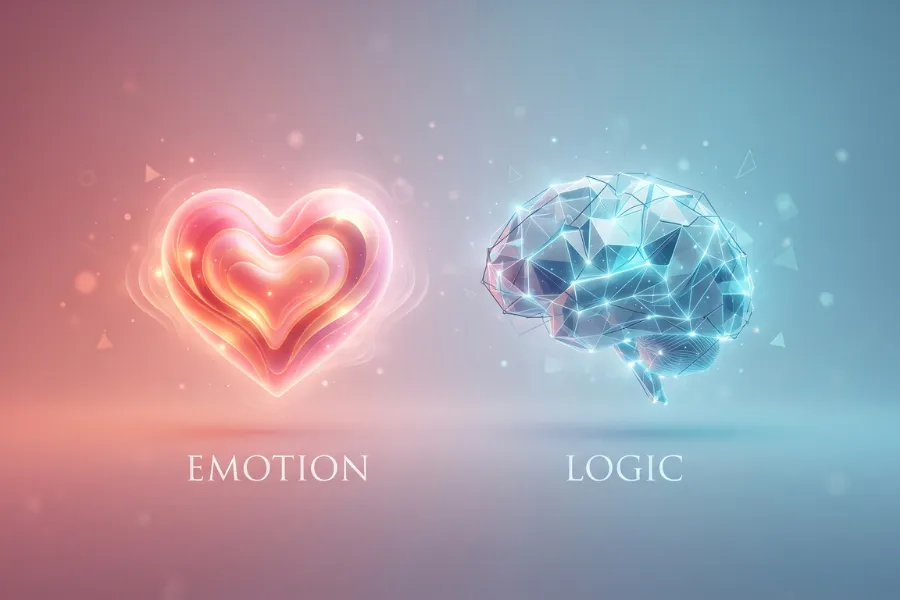
Logic and emotion work together continuously when we make choices.
- How Emotions Influence Decisions: Purely rational decision-making is largely a myth. Emotional responses provide instantaneous value assessments, guiding our choices before conscious logic ever finishes analyzing the data.
- Why Stress Can Change Our Choices: Elevated cortisol levels force the brain to prioritize immediate comfort and safety over long-term benefits. Consequently, high stress pushes people toward familiar, low-effort choices.
- Why Fear and Reward Affect Behavior: Fear triggers rapid avoidance strategies, whereas anticipated rewards release dopamine, driving action. Balancing these twin forces forms the core framework of human motivation.
- Why People Sometimes Make Irrational Decisions: Cognitive biases, emotional impulses, and limited processing power frequently override logic, leading people to act against their own long-term best interests.
Psychological Facts About Social Behavior and Relationships

Human beings are fundamentally social creatures whose behavior changes dramatically in group settings.
                    ┌─────────────────────────────────────────────────┐
                    │          Social Dynamics & Connections          │
                    └────────────┬────────────────────────────────────┘
                                 │
         ┌───────────────────────┼───────────────────────┐
         │                       │                       │
         ▼                       ▼                       ▼
┌─────────────────┐     ┌─────────────────┐     ┌─────────────────┐
│ Social Proof    │     │ Behavioral      │     │ Rejection Pain  │
│ Seeking guidance│     │ Mimicry         │     │ Processing via  │
│ from group      │     │ Subconscious    │     │ physical distress│
│ choices.        │     │ gesture mirroring│    │ brain networks. │
└─────────────────┘     └─────────────────┘     └─────────────────┘
Why People Conform to Groups
Conformity stems from two main drivers: the desire to fit in socially and the assumption that the collective group possesses better information than an isolated individual (social proof).
Why Familiar People Can Feel More Comfortable
Predictability reduces psychological anxiety. Because familiar individuals present fewer unknown risks, our subconscious mind interprets their presence as safe and comforting.
Why First Impressions Matter
First impressions establish an anchor in social interactions. Thanks to confirmation bias, people continuously look for subsequent behaviors that validate their initial assessment.
Why People Mirror Others
Subconscious physical mirroring—such as matching someone’s posture or breathing pace—signals goodwill. It helps establish rapport and build mutual trust smoothly during conversations.
Why Social Rejection Can Feel Painful
Neuroscience shows that social rejection activates the anterior cingulate cortex—the exact brain region that processes physical pain. To our early ancestors, group ostracism meant probable death, so the brain evolved to treat social separation as a severe threat.
Psychological Facts in Everyday Life
Psychological principles actively influence our daily choices, from store layouts to social media scrolling.
Psychology of Shopping
- Scarcity: Limited-time sales induce urgent buying behavior.
- Social Proof: High star ratings and user testimonials reassure uncertain shoppers.
- Familiarity: Recognized brand logos inspire higher purchase confidence.
- Loss Aversion: Free trial offers capitalize on the reluctance to give up access once experienced.
Psychology of Social Media
Social media apps leverage variable reward schedules to trigger dopamine releases, encouraging endless scrolling. Furthermore, confirmation bias leads users to engage predominantly with content that reinforces their existing worldview, while social comparison dynamics directly impact self-esteem.
Psychology of Relationships
Long-term relationships rely heavily on healthy communication patterns, shared experiences, and emotional empathy. Reciprocal self-disclosure builds deeper intimacy over time, while frequent physical mirroring maintains nonverbal connection.
Psychology of Habits
Habits operate within a simple three-part loop: a cue, a routine, and a reward. Repeating this sequence under similar environmental cues transforms complex choices into fast, automatic behaviors that require minimal conscious effort.
Are Psychological Facts the Same for Everyone?
Psychological studies reveal baseline patterns across populations, but they do not guarantee how any single person will react. Key individual variables include:
- Individual Personality Traits: Extroverts and introverts process social environments differently.
- Cultural Background: Western cultures often emphasize individual autonomy, whereas Eastern cultures frequently prioritize group harmony.
- Personal Context & Age: Life experience, personal trauma, and age significantly modify cognitive processing styles.
- Research Limitations: Many classic psychological studies were conducted on specific, non-representative sample groups.
Ultimately, psychological facts serve as insightful frameworks rather than absolute predictions for human behavior.
5 Psychological Facts Everyone Should Know
- The Mere Exposure Effect: Repeated exposure to something naturally boosts your liking for it.
- Confirmation Bias: You naturally notice and remember information that agrees with your personal beliefs.
- The Negativity Bias: Your brain processes negative experiences faster and retains them longer than positive ones.
- The Halo Effect: One prominent positive trait can bias your overall judgment of a person’s character.
- The Bystander Effect: You are statistically less likely to receive help in an emergency when a large crowd is present.
10 Quick & Interesting Psychological Facts
- Smell & Memory: Olfactory cues evoke stronger, more immediate emotional memories than visual cues.
- Choice Overload: Offering too many options often causes decision paralysis and lowers customer satisfaction.
- Sleep & Emotion: Sleep deprivation severely impairs your brain’s ability to regulate negative emotions.
- Physical Warmth: Holding a warm mug can make you perceive nearby individuals as interpersonally warmer.
- The Power of Framing: Presenting information positively (“90% fat-free”) alters perception compared to negative framing (“10% fat”).
- Sunk Cost Fallacy: People frequently persist in losing endeavors simply because they already invested time or money.
- Cognitive Dissonance: Holding two conflicting beliefs causes genuine psychological discomfort that drives people to justify their choices.
- Expressive Writing: Writing about painful emotional experiences can noticeably reduce physiological stress.
- Placebo Effect: Believing a treatment will work can trigger real, measurable physiological healing responses in the body.
- The Pratfall Effect: Competent individuals who make minor mistakes often become more likable to others.
What Are Dark Psychology Facts?
The term “dark psychology” refers to tactics used to persuade, manipulate, or control others. While “dark psychology” is popular in online discussions rather than a formal academic branch, it draws heavily on established principles of behavioral and social psychology.
- Manipulative Persuasion: Using cognitive biases, like artificial scarcity or forced reciprocity, to coerce choices.
- Gaslighting: Systematically undermining someone’s trust in their own memory, perception, or sanity.
- Coercive Social Influence: Exploiting natural desires for social approval to control individual behavior.
Understanding these underlying mechanisms empowers people to spot covert manipulation, guard their personal boundaries, and make clear-headed choices.
What Are the 7 Major Psychological Theories?
Academic psychology relies on seven primary perspectives to explain human behavior:
Behavioral Theory
Focuses entirely on observable behaviors and environmental learning processes, such as classical and operant conditioning.
Cognitive Theory
Examines internal mental processes, including how people store memory, process language, solve problems, and make decisions.
Psychodynamic Theory
Originating with Sigmund Freud, this approach emphasizes subconscious drives, childhood conflicts, and hidden motivations.
Humanistic Theory
Emphasizes personal growth, individual free will, self-actualization, and human potential.
Biological Perspective
Analyzes physical, genetic, and neurological mechanisms to explain how brain chemistry shapes mind and behavior.
Evolutionary Perspective
Examines how evolutionary pressures and survival adaptations shaped modern human behavioral patterns.
Sociocultural Perspective
Investigates how cultural norms, social expectations, and community environments influence individual thoughts and actions.
Frequently Asked Questions About Psychological Facts
What are psychological facts?
Psychological facts are research-backed findings that explain predictable patterns in human cognition, emotional responses, memory, and social behavior.
What are 5 interesting psychological facts?
Five standout facts include the Mere Exposure Effect, Confirmation Bias, Negativity Bias, the Bystander Effect, and the Dunning-Kruger Effect.
What are 10 interesting facts about psychology?
Ten key facts highlight how smell triggers vivid memories, choice overload paralyzes decision-making, physical warmth promotes social trust, and sleep deprivation disrupts emotional regulation.
What is the most interesting fact about human psychology?
One of the most profound facts is neuroplasticity—the reality that your brain physically alters its neural pathways in response to new thoughts, skills, and daily habits.
What are some psychological facts about human behavior?
Human behavior is deeply influenced by social proof, cognitive biases like loss aversion, physical mimicry, and the fundamental attribution error.
Are psychological facts scientifically proven?
Valid psychological facts rest on rigorous scientific studies, but they represent strong behavioral trends across populations rather than rigid, universal laws.
Do psychological facts apply to everyone?
Not identically. Individual personality traits, cultural settings, upbringing, and immediate environments heavily influence how these principles manifest.
What are dark psychology facts?
Dark psychology explores how manipulative individuals exploit natural cognitive biases, social influence, and emotional vulnerabilities to control others.
What are the 7 major psychological theories?
The seven major perspectives are Behavioral, Cognitive, Psychodynamic, Humanistic, Biological, Evolutionary, and Sociocultural theories.
Can psychology explain why people behave differently?
Yes. Psychology analyzes how unique blends of biological factors, personal history, cultural values, and environmental triggers shape distinct individual behaviors.
Final Thoughts
Exploring psychological facts helps demystify why we think, react, and make decisions the way we do. Recognizing how mechanisms like confirmation bias, emotional memory, and social proof operate gives you greater self-awareness in daily life. Ultimately, understanding the hidden patterns of the human mind empowers you to make smarter choices, build healthier relationships, and navigate social situations with clarity.