
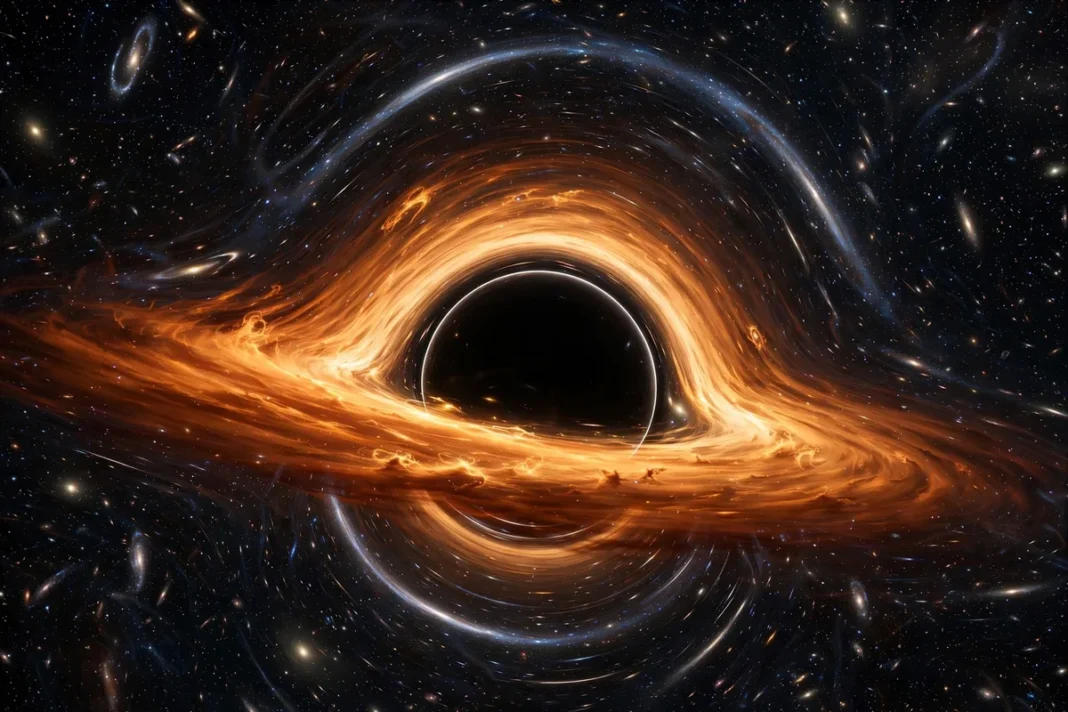

Supermassive Black Holes: 25 Amazing Facts About These Cosmic Giants
Somewhere at the center of our galaxy hides an invisible monster weighing as much as 4.3 million suns. It’s called Sagittarius A*, and it’s a supermassive black hole — one of the strangest objects in the universe. These cosmic giants can weigh millions or even billions of times more than our Sun, yet squeeze all that mass into a space smaller than our solar system. They shape entire galaxies, power the brightest objects ever seen, and warp space and time itself. Here are 25 amazing facts about them, from how they grow to what would happen if you fell into one.
What Is a Supermassive Black Hole?
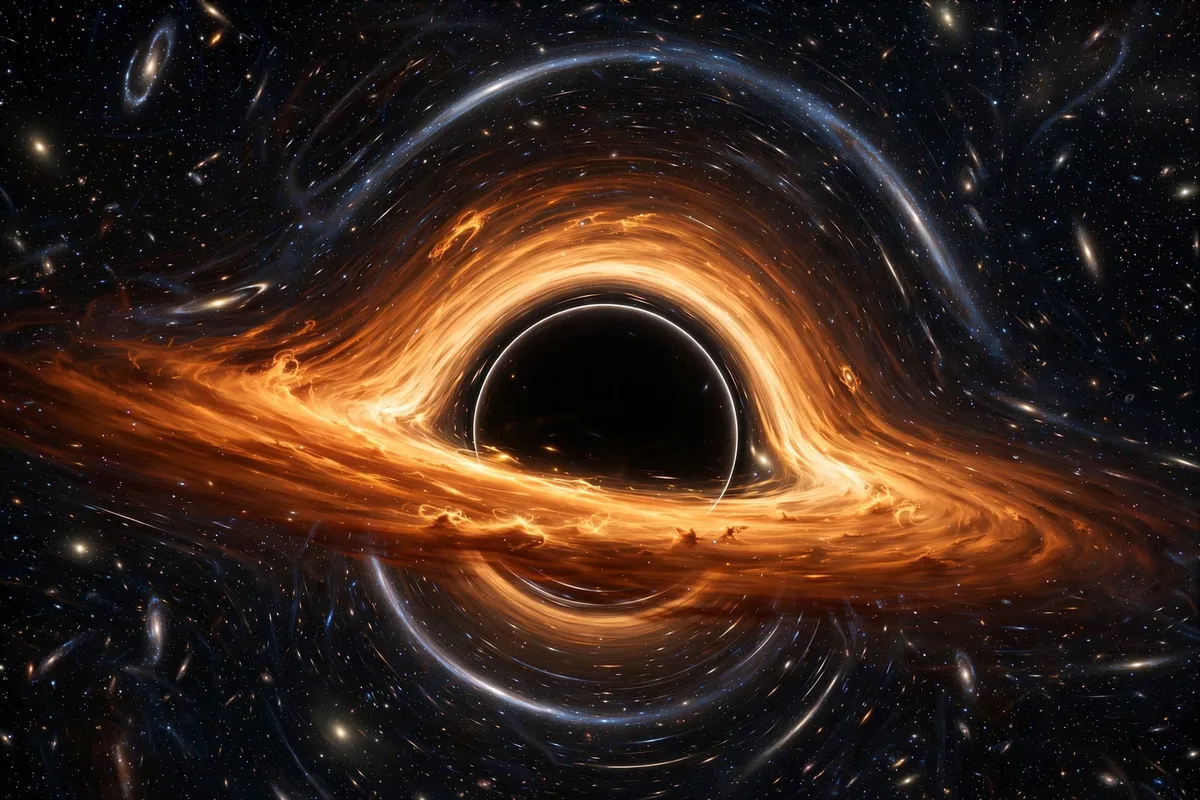
A supermassive black hole is a region where gravity is so intense that nothing — not even light — can escape past a boundary called the event horizon. An ordinary stellar-mass black hole (from a collapsed star) weighs about 5 to 20 suns. A supermassive one weighs millions to billions of solar masses — one solar mass being the mass of our Sun. The event horizon grows with mass, so the largest black holes have boundaries spanning thousands of times the Earth-Sun distance. If cosmic extremes fascinate you, our fun facts about science explores more wonders of the universe.
25 Amazing Supermassive Black Hole Facts
1. Most Large Galaxies Have One at Their Center
Astronomers have found strong evidence that most large galaxies harbor a supermassive black hole at their core, including our Milky Way. The pattern is so consistent that scientists believe black holes and galaxies grow up together, shaping each other’s evolution across billions of years.
2. They Weigh Millions to Billions of Suns
The range is staggering. The smallest confirmed supermassive black holes weigh around 100,000 solar masses, while the largest candidates reach tens of billions. The gap between smallest and largest is like comparing a pebble to a mountain range — same physics, incomprehensibly different scales.
3. Sagittarius A* Anchors the Milky Way
Our galaxy’s central black hole, Sagittarius A* (pronounced “A-star”), weighs about 4.3 million solar masses and sits roughly 26,000 light-years away in the constellation Sagittarius. Surprisingly, it’s very quiet right now — astronomers call it “quiescent,” meaning it barely feeds compared to more active black holes.
4. We Proved It Exists by Watching Stars Orbit It
For over 20 years, astronomers tracked stars whipping around an invisible point at the galactic center. One star, S2, completes an orbit every 16 years. The math was undeniable: 4 million suns’ worth of mass packed into a space smaller than Pluto’s orbit. The work earned Reinhard Genzel and Andrea Ghez the 2020 Nobel Prize in Physics.
5. It Was Photographed in 2022
In May 2022, the Event Horizon Telescope released the first image of Sagittarius A* — a glowing ring of superheated gas around a dark shadow. It was harder to capture than the first black hole image because Sgr A* appears a thousand times smaller in the sky, and its gas orbits in minutes, blurring the picture.
6. TON 618 May Be the Most Massive One Known
TON 618 powers a hyperluminous quasar 10.8 billion light-years away. Its black hole has been estimated at 40 to 66 billion solar masses — different studies give different numbers, so scientists treat the exact figure cautiously. Guinness World Records lists it as the most massive observed black hole.
7. TON 618 Shines 140 Trillion Times Brighter Than the Sun
This mind-bending luminosity comes not from the black hole itself, which emits no light, but from gas spiraling inward at tremendous speed, heating to extreme temperatures before vanishing past the event horizon. Its light has traveled toward us for nearly 11 billion years.
8. It Could Swallow Our Solar System 40 Times Over
TON 618’s event horizon stretches about 1,300 astronomical units — over 60 times the distance from Pluto to the Sun. A beam of light would take weeks just to cross from one side of its shadow to the other.
9. Black Holes Grow by Feasting on Gas and Dust
Surrounding gas spirals inward through an accretion disk, where friction heats it to millions of degrees before it crosses the event horizon. This feeding can release so much energy that a well-fed black hole outshines its entire host galaxy.
10. Feeding Black Holes Can Become Blazing Quasars
An actively feeding supermassive black hole can power a quasar — among the most luminous objects in existence. But not every one is active: our Sagittarius A* is currently quiet. Astronomers call active centers “active galactic nuclei” (AGN), and their brightness depends on how much material the black hole is consuming.
11. They Can Fire Jets Thousands of Light-Years Long
Some black holes launch particle jets near light speed. Galaxy M87 hosts a famous one stretching 5,000 light-years — first noted as a “curious straight ray” by Heber Curtis in 1918, decades before black holes were understood. NASA’s IXPE observatory now studies these jets in X-ray light.
12. Black Holes and Galaxies Grow Up Together
A galaxy’s central black hole mass correlates with properties like the speed of stars in its core — evidence of coevolution. Feeding black holes may act as galactic thermostats: their outflows heat or expel star-forming gas, regulating how the galaxy itself grows.
13. Colliding Galaxies Create Black Hole Pairs
When galaxies merge, their central black holes can end up orbiting each other. In galaxy NGC 7727, astronomers found two — 6 million and 150 million solar masses — just 1,600 light-years apart. They should merge within about 250 million years.
14. Merging Black Holes Ripple Spacetime
Final mergers release gravitational waves, ripples in spacetime predicted by Einstein. Ground observatories have caught smaller black hole mergers since 2015. Supermassive mergers produce lower-frequency waves that future space-based detectors — millions of kilometers wide — are being designed to catch.
15. A Cosmic Gravitational “Hum” Was Detected in 2023
In June 2023, the NANOGrav collaboration reported evidence of a faint, all-sky gravitational wave background from 15 years of pulsar timing data. The likely source: countless supermassive black hole pairs across the universe, each adding its slow ripple to one deep cosmic hum.
16. Black Holes Can Shred Stars Apart
A star wandering too close gets ripped apart by the gravity difference between its near and far sides — a tidal disruption event. The debris glows so hot it can briefly outshine the entire galaxy. Astronomers have observed around 100 of these stellar shreddings.
17. Some Black Holes Wander Far From Home
Galaxy mergers can fling black holes thousands of light-years from the galactic core. In 2026, NASA’s Swift observatory confirmed a star being shredded by a “wandering” million-solar-mass black hole over 30,000 light-years from its galaxy’s center — only the second such offset event ever confirmed.
18. They Warp Space and Time Itself
Einstein’s general relativity says mass curves spacetime, and nothing curves it more than a black hole. Near the event horizon, the warping is so severe that all paths lead inward — which is why escape is impossible. Star orbits near Sagittarius A* keep confirming Einstein’s century-old predictions.
19. The First Black Hole Photo Was Taken in 2019
On April 10, 2019, the Event Horizon Telescope unveiled the first image of a black hole: the 6.5-billion-solar-mass giant in galaxy M87, 55 million light-years away. It showed a bright gas ring around a dark shadow, matching predictions precisely. Creating it took an Earth-sized virtual telescope and two years of data processing — a milestone that belongs among the great scientific discoveries of our time.
20. Light Takes Days to Cross M87’s Shadow
M87’s black hole shadow is so vast that light — at 670 million mph — needs about two and a half days to cross it. For TON 618, the trip would take weeks. Sagittarius A*’s shadow, by contrast, spans roughly half of Mercury’s orbit. These aren’t the black holes themselves, but silhouettes against glowing infalling gas.
21. Our Galaxy’s Black Hole Erupted 200 Years Ago
Sagittarius A* isn’t always sleepy. NASA’s IXPE detected polarized X-rays bouncing off nearby gas clouds, revealing a dramatic flare about 200 years ago — briefly as bright as an entire active galaxy. That ancient outburst’s light still echoes off surrounding clouds today.
22. Falling In Would Stretch You Like Spaghetti
Stephen Hawking coined “spaghettification” in A Brief History of Time for how tidal forces stretch infalling objects lengthwise while squeezing them sideways. Around small black holes, this happens far outside the horizon. Around supermassive ones, tides at the horizon are gentler — you might cross intact, though the interior remains fatal.
23. Black Holes Don’t Suck Like Vacuum Cleaners
If our Sun were replaced by an equal-mass black hole, Earth and the other planets would keep orbiting exactly as before, NASA notes. The danger only starts extremely close in, where gravity becomes inescapable. At a distance, a black hole pulls just like any other massive object.
24. Even the “Small” Ones Are Enormous
The supermassive category starts around 100,000 solar masses. The dwarf galaxy 1601+3113 hosts one this size — yet it’s compressed so tightly its shadow is physically smaller than our Sun. Extreme density, not just mass, is what makes every black hole extraordinary.
25. How the First Ones Formed Is Still a Mystery
The James Webb Space Telescope keeps finding billion-solar-mass black holes in the infant universe — seemingly too early for slow growth. Two theories compete: light seeds (collapsed first stars of 10–100 solar masses, growing over time) and heavy seeds (primordial gas clouds collapsing directly into 10,000+ solar-mass black holes). Neither is confirmed — the answer could rewrite cosmic history.
What Is the Biggest Supermassive Black Hole Ever Found?
The commonly cited record-holder is TON 618 — but the honest answer carries an asterisk, because its exact mass is genuinely uncertain.
Why Is TON 618 Considered So Massive?
Nobody can weigh a black hole directly. Astronomers measure how fast superheated gas orbits it — faster gas means stronger gravity, meaning a heavier black hole. For TON 618, one analysis gave 66 billion solar masses; a later recalculation suggested around 40 billion. Both are indirect estimates. Even the lower figure exceeds the combined mass of all stars in the Milky Way.
TON 618 vs Sagittarius A*
| Feature | Sagittarius A* | TON 618 |
|---|---|---|
| Location | Center of the Milky Way | Distant quasar, 10.8 billion light-years away |
| Mass estimate | ~4.3 million solar masses | ~40–66 billion (estimates vary) |
| Distance from Earth | ~26,000 light-years | ~10.8 billion light-years |
| Activity | Currently quiet | Hyperluminous quasar, actively feeding |
| First imaged | 2022 (Event Horizon Telescope) | Never directly imaged (too distant) |
How Do Supermassive Black Holes Form?
Growth Through Gas Accretion
The main growth engine is devouring gas. Material spirals through an accretion disk, heating to millions of degrees and radiating enormous energy before crossing the horizon. Over billions of years, steady feeding builds modest black holes into galactic heavyweights — the brightest quasars mark the most intense feeding frenzies.
Growth Through Galaxy Mergers
When galaxies collide, their central black holes eventually pair up, spiraling inward over millions of years as gravitational interactions drain their orbital energy. The final merger emits gravitational waves — and can even kick the merged black hole clean out of the galactic center.
How Did the First Ones Form?
Here certainty ends. Light seed theory says the first massive stars collapsed into 10–100 solar-mass black holes that merged and grew — but Webb’s early-universe giants seem too big, too soon for this. Heavy seed theory proposes primordial gas clouds collapsing directly into 10,000+ solar-mass black holes, skipping stars entirely. Both are active research areas; neither is proven.
What Would Happen If You Fell Into a Supermassive Black Hole?
Would You Be Spaghettified?
Eventually, yes — tidal forces would stretch you lengthwise and squeeze you sideways. But around a supermassive black hole, these forces are gentler at the horizon because gravity changes gradually across such a vast region. You might cross the point of no return intact, unlike with a small black hole that would tear you apart far outside it.
Could You Survive Crossing the Event Horizon?
You could cross it alive — but that’s where survival ends. Inside, every path curves toward the center, where tidal forces become infinitely strong. No hovering, no turning back. And if the black hole is actively feeding, its accretion disk radiation would likely kill you before you even arrived.
Can You See Inside a Black Hole?
No. Inside the event horizon, gravity bends every path — including light’s — inward, so no information about the interior can ever escape. From inside, you could still see outward, watching a universe you can never return to.
How Do Scientists Detect Supermassive Black Holes?
Tracking Stars Around Sagittarius A*
The gold standard: watch things orbit the invisible mass. Twenty-plus years of tracking stars near our galactic center revealed high-speed orbits around a 4.3-million-solar-mass point — something only a black hole can explain. This stellar dynamics technique remains among the most reliable detection methods.
Studying X-Rays and Accretion Disks
Feeding black holes glow in X-rays as infalling gas superheats. NASA’s Chandra observatory has mapped these beacons for decades, while the IXPE mission studies their polarized light to reveal magnetic structures near the horizon. Where visible light shows nothing, X-rays catch black holes mid-meal. See NASA’s black hole overview for more on these missions.
Detecting Black Hole Mergers
Merging supermassive black holes emit gravitational waves at frequencies too low for ground detectors. Instead, astronomers use pulsar timing arrays — networks of spinning neutron stars whose ultra-precise radio pulses arrive slightly early or late as waves pass through. NANOGrav’s 2023 detection used 15 years of such data.
What Future Telescopes May Reveal
The Thirty Meter Telescope (TMT), once complete, will resolve stars orbiting black holes in unprecedented detail. NASA’s upcoming Roman Space Telescope will survey the early universe where the first giants emerged. These are future capabilities — but they may finally reveal how supermassive black holes were born.
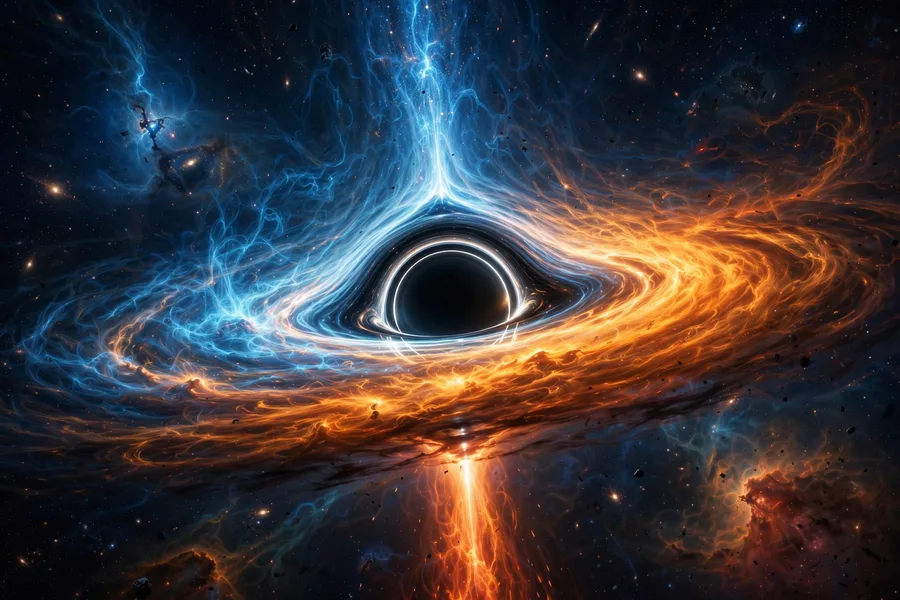
Frequently Asked Questions About Supermassive Black Holes
Why Is TON 618 So Scary?
Its scale inspires awe — tens of billions of solar masses, outshining trillions of suns. But it’s 10.8 billion light-years away and poses zero threat to Earth. The “scary” is pure cosmic wonder at something so far beyond human scale.
How Long Could You Survive Inside One?
No universal number exists — it depends on the black hole’s mass, spin, and activity. Around a truly enormous one, you might cross the horizon unharmed and persist for a while inside. But escape becomes impossible the instant you cross, and the interior is ultimately lethal.
What Is the Biggest Black Hole Ever Found?
TON 618 is the most cited candidate, at an estimated 40–66 billion solar masses, recognized by Guinness World Records. But these are indirect estimates with real uncertainty — astronomers treat it as the leading candidate, not an unchallengeable record.
Is a Supermassive Black Hole Bigger Than the Sun?
In mass, enormously — millions to billions of times heavier. The event horizon scales with mass too: TON 618’s spans thousands of Earth-Sun distances. Yet all that mass is crushed into an incredibly tiny volume, which is exactly what makes its gravity so extreme.
Does Every Galaxy Have One?
Not proven for every galaxy, but most large ones show evidence of a central supermassive black hole. Smaller dwarf galaxies are less certain. “Most large galaxies” is accurate — “every single galaxy” goes beyond the evidence.
Can One Destroy Its Galaxy?
No. A black hole can’t suddenly swallow its host galaxy — its gravity only dominates the central region. But an actively feeding one influences its galaxy over billions of years: jets and radiation can heat or expel star-forming gas, regulating galactic growth. Influence, not annihilation.
What’s the Difference Between Black Hole Types?
It’s all about mass. Stellar-mass black holes (5–20 suns) come from collapsed stars. Intermediate-mass ones (hundreds to hundreds of thousands of suns) are rare and poorly understood. Supermassive black holes (millions to billions of suns) anchor galaxy centers. Same physics — vastly different scales.
The Bottom Line
Supermassive black holes prove the universe is stranger than intuition allows: billion-sun masses hiding invisibly at galactic hearts, shaping everything around them, revealing themselves only through doomed gas and dancing stars. We’ve photographed two, weighed dozens, and heard the gravitational whispers of countless mergers. Yet how the first giants formed remains unanswered — and the next generation of telescopes may finally tell us.
Sources: NASA Science (Chandra, IXPE, Swift); Event Horizon Telescope Collaboration (2019, 2022); NANOGrav 15-year dataset (2023); Guinness World Records; Sloan Digital Sky Survey.